
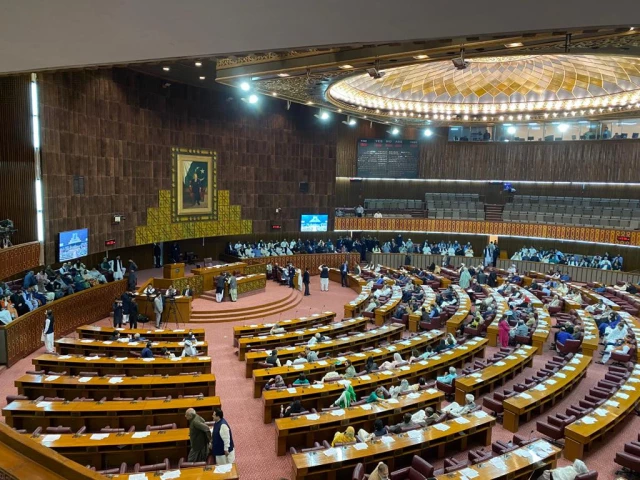
Pakistan’s National Assembly and Senate approved two significant pieces of legislation on Thursday, both tied to the country’s military hierarchy and nuclear command framework. Lawmakers passed the bills by majority vote in both chambers.
The first of these, the Defence Forces Act 2026, establishes a formal legal structure for the country’s top military leadership. The second bill introduces amendments to the National Command Authority Act 2010, which governs oversight of Pakistan’s strategic and nuclear assets.
Both bills cleared the National Assembly before moving to the Senate, where they also secured majority approval. Shortly before the parliamentary vote, the federal cabinet had already given its endorsement to the draft legislation during a session led by Prime Minister Shehbaz Sharif.
Why the Defence Forces Act 2026 Was Needed
According to cabinet officials, the Defence Forces Act 2026 was drafted to create a proper legal and administrative foundation for two new institutions, the office of the Chief of Defence Forces and the Chief of Defence Forces Headquarters. The cabinet also signed off on revisions to the 2010 National Command Authority Act during the same meeting.
Both pieces of legislation work to implement structural changes set in motion by the 27th Constitutional Amendment, passed by parliament in November of last year. That amendment reshaped major elements of Pakistan’s judicial system and military command hierarchy.
Among its most notable changes, the constitutional amendment did away with the position of Chairman of the Joint Chiefs of Staff Committee, replacing it with a newly formed role, the Chief of Defence Forces. Field Marshal Asim Munir, previously serving as Chief of Army Staff, went on to become the first officer to hold this new position.
The amendment also paved the way for a separate body known as the National Strategic Command, led by a four-star general responsible for coordinating the operational functions of Pakistan’s strategic forces. To fill this role, Prime Minister Shehbaz Sharif elevated Gen Raza, who had been serving as Chief of the General Staff, promoting him from lieutenant general to four-star rank.
With the Defence Forces Act 2026 now passed, these command structures gain the legal backing needed to function under the framework set out by last year’s constitutional changes.