
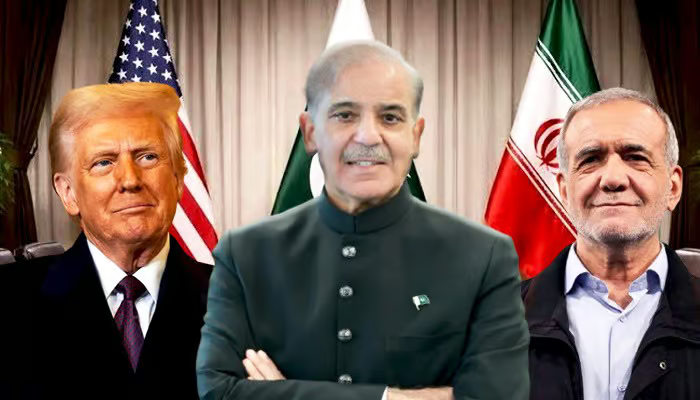
Prime Minister Shehbaz Sharif announced on Thursday that the United States and Iran have signed the Islamabad MoU, a landmark agreement aimed at ending the conflict between the two countries through diplomacy.
In a statement shared on X, the prime minister said the memorandum was electronically signed by the presidents of both countries and endorsed by Pakistan in its role as mediator.
According to Shehbaz, the signing of the agreement reflects the commitment of both Washington and Tehran to resolving their differences through dialogue rather than conflict.
He said the Islamabad MoU would come into force immediately. As part of the first phase of the agreement, Iran will reopen the Strait of Hormuz, while the United States will lift its naval blockade.
The prime minister congratulated US President Donald Trump for supporting a diplomatic solution and helping prevent a wider regional crisis. He also acknowledged the efforts of the American negotiating team, including Vice President J.D. Vance, Steve Witkoff and Jared Kushner.
Shehbaz also praised Iran’s leadership, including Supreme Leader Ayatollah Seyyed Mojtaba Khamenei and President Masoud Pezeshkian, for what he described as their commitment to peace and constructive engagement. He further recognized the contributions of Iranian negotiators Mohammad Bagher Ghalibaf, Abbas Araghchi and Eskandar Momeni.
The prime minister thanked the leadership of Qatar for its constructive role in helping facilitate the agreement. He also commended Saudi Arabia, Türkiye and Egypt for their support and contributions to the peace process.
Highlighting Pakistan’s role in the negotiations, Shehbaz paid special tribute to Field Marshal Syed Asim Munir, saying his efforts and dedication were instrumental in achieving the breakthrough and promoting regional stability.
The prime minister expressed hope that the Islamabad MoU would serve as a lasting foundation for greater understanding, mutual respect and shared prosperity across the region.
He said the agreement marks an important step toward peace and could help reduce tensions while creating opportunities for stronger regional cooperation in the future.