
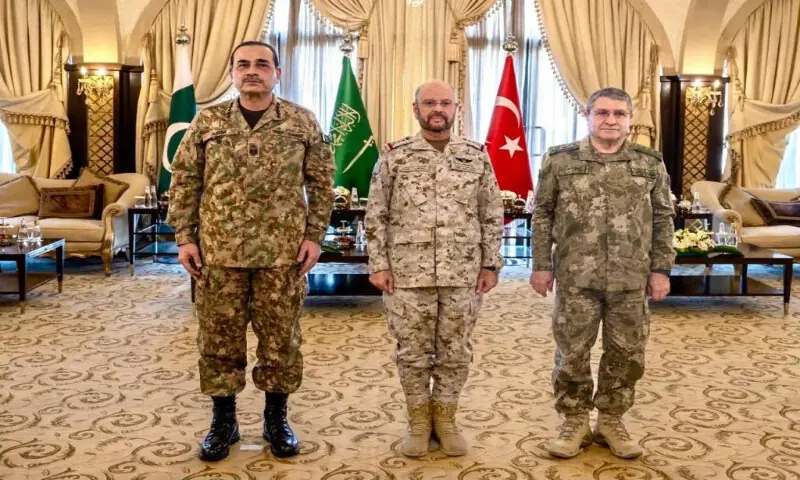
Türkiye has moved closer to formally approving a trilateral defence agreement with Pakistan and Saudi Arabia by submitting the pact to its parliament for ratification, according to three parliamentary sources cited by Reuters. The development could strengthen military cooperation among the three countries as Saudi Arabia faces security threats, including attacks by Yemen’s Houthi movement.
Signed in August, the Makkah Joint Defence Alliance establishes a mutual defence commitment under which an armed attack against one signatory is treated as an attack against all three. The agreement requires the countries to provide assistance to a member facing external aggression, subject to the pact’s provisions.
The move brings Türkiye, which has NATO’s second-largest military, closer to a formal security commitment with Riyadh and Islamabad. Parliamentary ratification is required before Ankara can complete its approval process.
Pakistan Saudi Turkey Defence Pact Includes Mutual Assistance Clause
The agreement establishes a framework for collective action against threats to the territorial integrity, sovereignty and internationally recognised borders of its members.
Article 1 calls on the signatories to employ all necessary means to address threats against one another. Article 2 outlines the response to an armed attack or military aggression by another country or group of countries.
Under the second article, the parties are required to provide immediate assistance to the member under attack, drawing on the available measures for mutual support. The precise form and extent of that assistance will depend on an objective assessment of the circumstances and the support required.
The provision resembles NATO’s Article 5, which establishes the principle of collective defence among alliance members. The trilateral agreement also refers to Article 51 of the United Nations Charter, which recognises the inherent right of individual and collective self-defence following an armed attack.
However, the agreement leaves the participating countries to determine the nature and scope of their response in accordance with their available resources, including military capabilities.
Defence Pact Sets a Minimum 10-Year Commitment
The agreement includes provisions intended to maintain the partnership over the long term. None of the three countries can withdraw during the first 10 years after the pact enters into force.
Following that initial period, a signatory wishing to leave must provide the other two countries with at least three months’ written notice through diplomatic channels.
The pact is designed to remain in force indefinitely, subject to its withdrawal provisions. A country’s departure would not automatically cancel activities or projects agreed upon before its withdrawal.
Confidentiality obligations would also continue to apply after a member leaves the arrangement. The agreement requires all three countries to protect classified documents and information obtained under its provisions and prohibits their disclosure or transfer to states, companies or individuals outside the agreement.
Any amendments must be considered through consultations and receive unanimous approval from the agreement’s designated Core Parties, according to the text.
Türkiye and Saudi Arabia Strengthen Military Cooperation
The defence partnership has gained added significance amid regional security concerns. At an emergency meeting of the alliance in Riyadh earlier this month, the three countries agreed to ensure the rapid deployment of military forces and capabilities in Saudi Arabia amid Houthi attacks.
Türkiye has condemned attacks by the Houthi movement against Saudi Arabia and expressed readiness to help address the kingdom’s military technology requirements.
Ankara has also agreed to join a Saudi-led coalition aimed at protecting maritime navigation in the Red Sea, an important route for international trade and shipping.
Beyond mutual defence commitments, the agreement envisages broader collaboration in military production, intelligence sharing, logistics and counterterrorism. It also provides for joint training programmes and cooperation in research, development and advanced technologies.
These provisions could create additional opportunities for the three countries to coordinate their defence industries, exchange expertise and improve their military capabilities.
Türkiye’s Parliament to Review the Agreement
The Turkish parliament’s Foreign Affairs Committee is expected to examine the agreement as part of the ratification process.
Parliament Speaker Numan Kurtulmus, who is visiting Kyrgyzstan, will refer the document to the committee after returning to Türkiye, two parliamentary sources told Reuters. Another source said the committee could begin debating the pact as early as Friday.
The submission represents a key procedural step towards formal Turkish approval. The agreement’s implementation will depend on the completion of the necessary domestic procedures.
Burhanettin Duran, communications director for Turkish President Recep Tayyip Erdogan, described the development as an important milestone in strengthening strategic cooperation among the three countries.
In a post on X, Duran said the partnership was intended to improve collective deterrence, develop joint defence capabilities and protect regional security and stability.
Will Türkiye Send Troops to Defend Saudi Arabia?
Despite the agreement’s mutual defence provisions, Türkiye’s expected military contribution may initially focus on equipment, technology and intelligence rather than deploying troops abroad.
A Turkish official, speaking anonymously, told Reuters that Ankara’s anticipated support would be limited to military equipment, intelligence sharing and weapons systems. The official added that no other form of deployment had taken place under the alliance so far.
Turkish Foreign Minister Hakan Fidan has also clarified that the Makkah Agreement is not intended as an offensive military arrangement.
Responding to questions about potential Turkish assistance to Saudi Arabia against Houthi attacks originating from Yemen, Fidan said Türkiye would not send troops to another country to conduct attacks on its territory.
Türkiye’s constitution separately requires parliamentary authorisation for deploying troops abroad, even when an international agreement provides a framework for military cooperation.
This distinction is significant because the pact establishes a commitment to mutual assistance without automatically authorising every possible form of military intervention.
What the Pakistan Saudi Turkey Defence Pact Means for Regional Security
The agreement signals an effort by Pakistan, Saudi Arabia and Türkiye to strengthen coordination in response to shared security concerns. Its provisions cover not only military assistance but also intelligence, defence technology, logistics, training and counterterrorism.
For Saudi Arabia, the arrangement could provide additional avenues for security cooperation as it confronts regional threats. For Pakistan and Türkiye, it offers a framework for closer strategic coordination and potential collaboration between their defence industries.
The pact’s practical impact will depend on how the three countries implement its provisions, assess future threats and determine what assistance is required in individual circumstances.
Türkiye’s parliamentary ratification process is therefore an important next step. If approved, it would move the trilateral arrangement closer to formal implementation and strengthen the institutional foundations of cooperation among the three countries.