
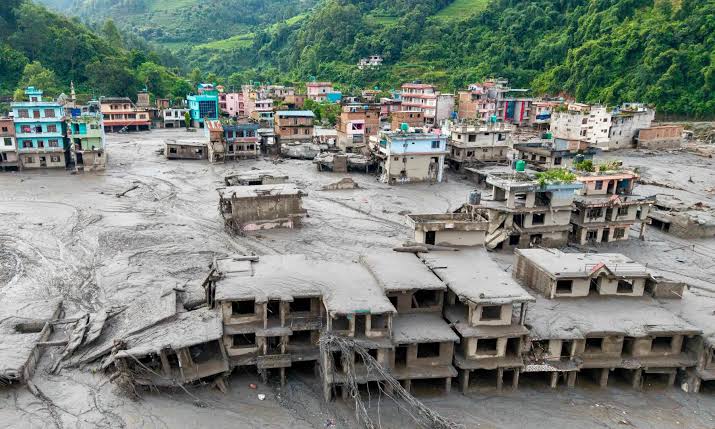
Heavy machinery cut through layers of mud and wreckage in flood-ravaged towns across Nepal on Friday, as crews raced to locate survivors two days after a glacier collapse triggered one of the region’s deadliest disasters in recent memory. Officials are now also scrambling to prevent a second wave of destruction.
The Nepal flash flood death toll reached 469 early Friday, with nearly 1,000 people still unaccounted for across Nepal and neighboring Tibet. The catastrophe began Wednesday morning when a glacier gave way, unleashing a massive surge of rock, ice, mud and debris down through river systems in the Himalayas.
The torrent tore through communities and mountain valleys, wrecking power infrastructure, roads and bridges along a corridor connecting Kathmandu to Lhasa, a route frequently used by trekkers and religious pilgrims. Among the missing, at least 540 are foreign nationals.
Rescue Operations Race Against Time
Nepali authorities deployed helicopters to scan for survivors and deliver emergency supplies to communities cut off by the disaster. Ground teams, aided by sniffer dogs, pulled dozens of bodies from areas where the water had carried them into lower-lying plains.
Among those pulled to safety was Dibga Tamang, rescued Thursday from the badly hit town of Rasuwa and flown by helicopter with three others to an army base in Nuwakot. “All of our people have gone. They are dead,” he said. “I have no one left waiting for me. Everything and everyone is gone. The end.”
Barrier Lake Raises Fears of New Flooding
Beyond the search for survivors, the sheer volume of displaced water and debris has created a fresh danger. Nepal’s disaster management agency cautioned that a lake forming behind a debris blockage on the Bhotekoshi River was swelling and could burst.
Across the border, Chinese officials reported that roughly three million cubic metres of water, comparable to about 1,200 Olympic swimming pools, is projected to pour into an already-dammed lake over the following three days. State media, citing the water resources ministry, said a breach was a serious possibility, with the water level expected to peak around September 1.
China has sent in an eight-person engineering team to run aerial surveys and build 3D models of the barrier lake, though reaching the site has proven difficult. Engineer Chen Hanxiao told state broadcaster CCTV that the glacier collapse left behind numerous isolated and steep cliffs surrounding the newly formed lake.
According to Chen, the standard method for easing pressure on such a lake involves cutting a drainage channel at a lower section of the natural dam, though the channel’s exact dimensions depend on calculations involving inflow speed and how quickly the lake is filling. Engineers are now focused on monitoring the lake, gathering data from its floor, and tracking weather conditions in the days ahead.
Border Crossing Among Worst-Hit Areas
On the Chinese side, rescue teams had not yet reached the Gyirong border crossing, the area hit hardest by the flood, as of Thursday evening, according to state media, with crews still working to clear debris blocking the main access road.
Footage captured Wednesday showed powerful surges of muddy water and debris ripping through buildings at the crossing within seconds, sweeping away people who were attempting to escape. CCTV reported Thursday that 558 people remained missing in Tibet’s Gyirong County, including 260 foreign nationals, though only three deaths had been confirmed on the Chinese side by that point.
China’s Premier Li Qiang, the country’s second-ranking official, traveled to the disaster zone in Gyirong on Thursday afternoon, according to state news agency Xinhua, a visit signaling that Beijing regards the disaster as a top national concern.
Families Await Word on Missing Loved Ones
Around the globe, relatives of the missing were left anxiously waiting for updates. Sneha Sudhir was among ten women whose husbands, all from northern Virginia, had departed on a trekking expedition toward Tibet’s Mount Kailash just before the disaster struck. The group is part of a larger number of Americans still unaccounted for.
“Where are they?” Sudhir asked, speaking tearfully from her home in Chantilly, Virginia, on Thursday. She said the women had been leaning on one another for support while contacting officials, lawmakers, and loved ones in both the United States and India in search of answers. “Everybody is taking turns in shedding their tears, wiping it off and getting back to work,” she said.
President Donald Trump confirmed that the United States had extended assistance to Nepal, saying, “Nobody’s ever seen anything quite like that, where very powerful, strong, well-built buildings were wiped out like they were toothpicks. It’s a terrible thing. We are sending aid and we’ve spoken to the leadership and we let them know anything they want, they’ll have.”
In Chitwan district, roughly 100 kilometers from the epicenter of destruction in Trishuli, administrator Ganesh Aryal said 103 bodies had been recovered from local river systems. With area hospitals overwhelmed and unable to hold all the recovered remains, district officials began setting up tents so families could identify and claim relatives.
Nepal’s Prime Minister Balendra Shah, who traveled to flood-affected Nuwakot on Thursday, acknowledged that conditions remained dire. “All the state agencies are operating at full capacity. Our first priority now is to save life of each citizen, search and rescue of the missing, treat the injured and provide immediate relief to the affected families,” he said.
The disaster marks a significant test for Shah’s government, now just five months old. Officials noted, however, that Nepal has institutional experience managing large-scale tragedies, pointing to the 2015 earthquake that claimed nearly 9,000 lives as a precedent for coordinated national response.