NUML delegation visits Khyber Network Islamabad as part of an academic engagement aimed at exploring collaboration opportunities under the KAMTECH initiative. The visit focused on strengthening ties between media education and industry-based training.
A delegation from the Department of Media and Communication Studies, National University of Modern Languages (NUML), visited the Khyber Network Head Office in Islamabad. The visit included a detailed briefing on KAMTECH (Khyber Academy for Media Technologies) and its vision for media education reform in Pakistan.
The NUML delegation included Dr. Ayesha Siddiqua (Media Education Strategist / Head of Department, Media and Communication Studies), Mr. Babar Iqbal (Broadcast Media Specialist, In-Charge TV Studio & Campus Radio NUML FM 104.6, University Lecturer), Ms. Sidra Waqar (Visiting Faculty, Lecturer NUML), Mr. Shoaib (Visiting Lecturer NUML / Iqra University), Mr. Ayoub (Lecturer NUML), Ms. Faiza Khalid (Assistant Professor NUML), Mr. Zaid Bin Inam (Lecturer NUML), and Dr. Amna Zulfiqar (Associate Professor NUML).
From Khyber Network, the team was led by Mr. Kaiwan Hamid Raja (Chief Executive Officer, Khyber Digital / KAMTECH). He was joined by Ms. Marriam Kaiwan (President, KhudMukhtar SAWI), Mr. Bilal Nasr (GM Digital Presentations, Khyber Digital), Mr. Saif Ullah (Manager Digital Presentations, Khyber Digital), Ms. Uzma Naz (PR Officer, Khyber Digital), and Ms. Aisha Malik (Coordination Officer, Khyber Digital).
The session formally began with a welcome note by Mr. Kaiwan Hamid Raja, who highlighted the importance of strengthening linkages between academia and the media industry to equip students with practical, job-oriented skills.
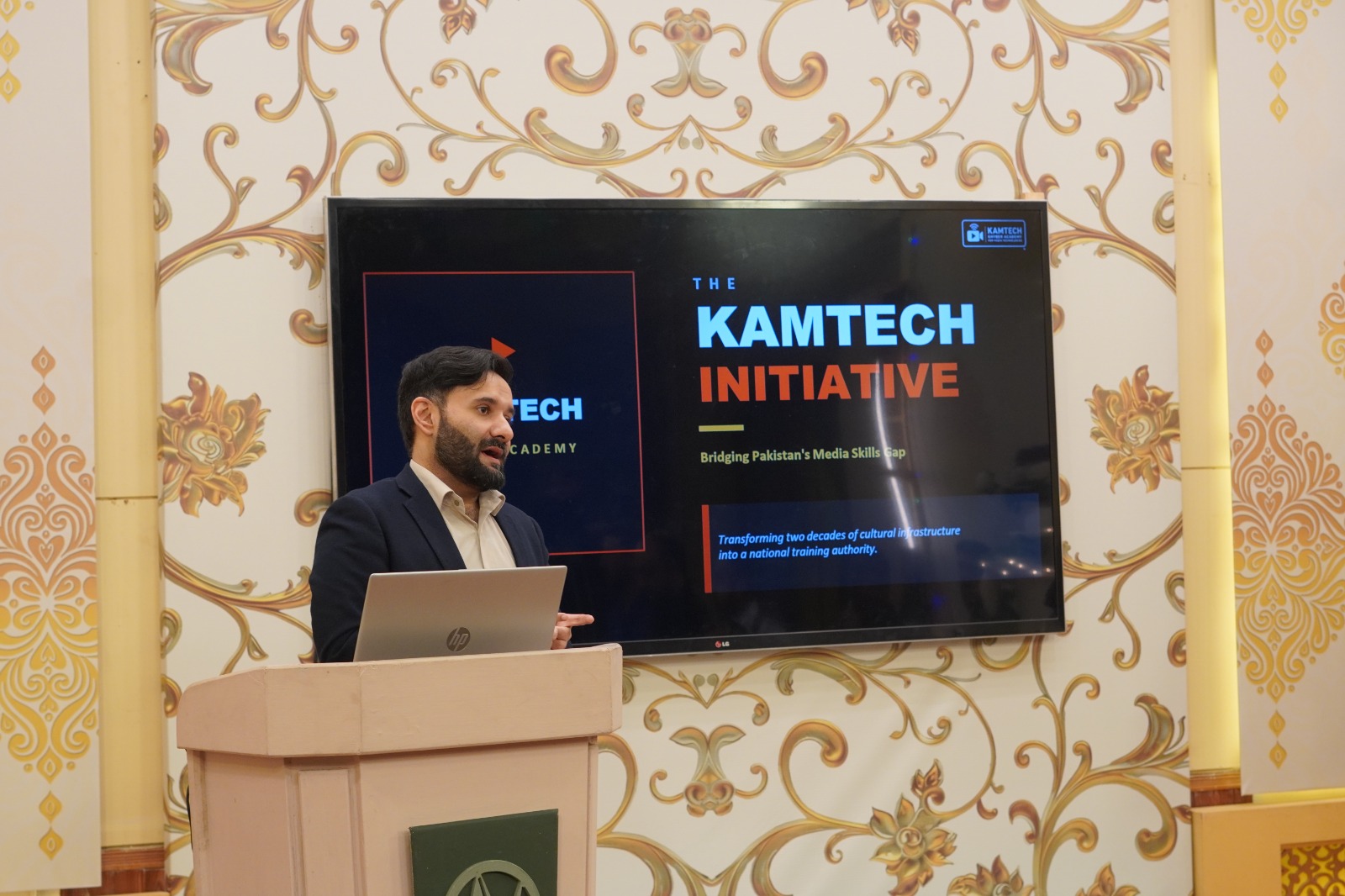
During the presentation on KAMTECH, Mr. Kaiwan Hamid Raja explained that KAMTECH (Khyber Academy for Media Technologies) is a strategic national initiative aimed at modernizing media education and professional training in Pakistan.
He described KAMTECH as a platform designed to bridge Pakistan’s media skills gap by converting decades of cultural and media infrastructure experience into a structured national training authority.
He also introduced the ATOM Council, an advisory and governance body comprising media owners, industry stakeholders, and university representatives. The council will provide strategic oversight and ensure industry-relevant curriculum, training standards, and institutional coordination within the KAMTECH ecosystem.
Another key focus of KAMTECH is its strategic partnerships framework, which includes universities as feeder institutions, government organizations, media houses, and international diplomatic missions to provide global exposure and collaboration opportunities for trainees.
Following the presentation, an interactive discussion session was held between the Khyber Network team and NUML faculty members. Both sides exchanged views on media training, internships, digital content development, and applied research opportunities for students.
Faculty members appreciated the initiative and shared suggestions on integrating industry-driven platforms into academic programs to improve student employability and skill development.
After the session, the NUML delegation was given a guided tour of various departments at Khyber Network. The visiting faculty expressed keen interest in the modern media equipment, advanced production setups, and digital broadcasting technologies being used at the organization. They appreciated the state-of-the-art infrastructure and its potential for enhancing hands-on learning opportunities for students.
The purpose of the visit was to introduce KAMTECH as a national media training framework and explore its alignment with academic institutions like NUML. The initiative aims to bridge Pakistan’s media skills gap, strengthen academia-industry linkages, establish governance through the ATOM Council, and build long-term partnerships with universities and media organizations.
The session concluded on a positive note with mutual agreement to continue collaboration under the KAMTECH framework. Both sides expressed optimism about strengthening Pakistan’s media education ecosystem and creating sustainable pathways between academic learning and professional media practice.