
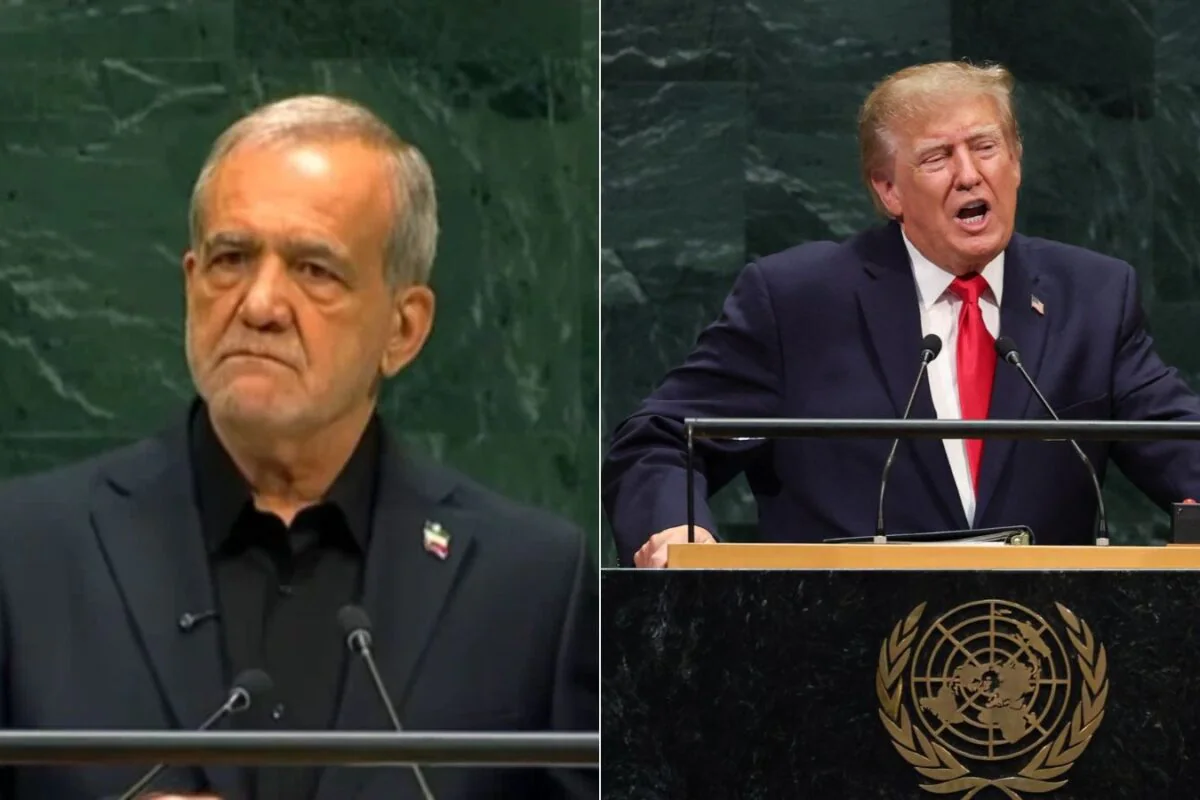
Iranian President Masoud Pezeshkian used a wartime speech before the United Nations General Assembly on Wednesday to accuse US President Donald Trump of displaying a “bullying mentality,” insisting that Iran would not capitulate in its ongoing conflict with Washington even as he signaled willingness to pursue diplomatic solutions.
Speaking to the 193-member assembly, Pezeshkian dismissed Trump’s earlier warning that the US could annihilate Iran absent a negotiated agreement, arguing that such threats would only strengthen his nation’s determination rather than weaken it.
Pezeshkian Pushes Back on Terrorism Label
“The remarks made by the US president yesterday… are a sign of a bullying mentality… The Iranian people will not bow to pressure… Those who are terrorists and train terrorists call us terrorists,” Pezeshkian said, pushing back against Trump’s characterization of Iran as the leading global sponsor of terrorism.
Throughout his address, the Iranian leader repeated that Tehran remained open to negotiations to de-escalate tensions with Washington, though he stressed his government would not respond to coercive tactics or the language of force.
Notably, the American delegation left the chamber as soon as Pezeshkian began speaking. Representatives from the US mission to the United Nations had not responded to requests for comment at the time of reporting.
Civilian Casualties Take Center Stage
Pezeshkian opened his remarks by accusing US forces of causing civilian deaths during the conflict, displaying photographs that included an image of schoolgirls seated in a classroom. He referenced a missile strike on a primary school in Minab on February 28, which occurred just hours after combined US and Israeli attacks on Iran ignited the broader war. Iranian officials say the strike killed more than 175 children and teachers.
The Pentagon has yet to publicly disclose findings from its inquiry into the Minab incident, which stands as the deadliest episode of civilian casualties tied to US military action in decades. Reuters reported on March 5 that a preliminary internal Pentagon assessment concluded American forces were likely behind the strike.
Iran Denies Pursuing Nuclear Weapons
Addressing nuclear concerns, Pezeshkian stated that Iran has no ambition to develop nuclear weapons but will not abandon its right to maintain a peaceful nuclear program. “Neither nuclear weapons nor giving up nuclear knowledge,” he said.
Seven months into a war that has unsettled global markets and brought the Gulf region close to a broader confrontation, the United States has intensified economic pressure on Tehran after military strikes failed to compel Iranian capitulation. Iranian officials worry that a deteriorating economy, characterized by rising prices, sluggish trade, and strained household budgets, could spark renewed domestic unrest of the kind that has periodically challenged the Islamic Republic’s stability.
Strait of Hormuz Remains Key Flashpoint
The Strait of Hormuz, through which roughly a fifth of the world’s oil and liquefied natural gas passes, has emerged as a central point of contention between Tehran and Washington. Sources close to the Iranian government told Reuters on Tuesday that Tehran has relayed, through intermediaries, the conditions under which it would allow the strategic waterway to reopen fully to American vessels.
“It cannot be the case that everyone benefits from the Strait of Hormuz while we are denied access to shipping through this waterway. The permanent deployment of hostile fleets and the expansion of the war will not lead to peace,” Pezeshkian said, underscoring Iran’s position that continued military presence in the region only deepens the standoff rather than resolving it.