
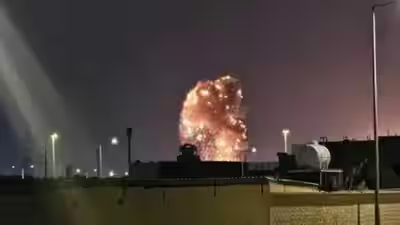
The United States has carried out military strikes on Iran’s strategic Qeshm Island, according to US officials, marking the latest development in a series of largely undisclosed military operations against Tehran.
The strikes took place on the night of November 2, just hours before the US midterm elections. The operation comes as President Donald Trump publicly rules out the possibility of a new war with Iran while signalling progress on diplomatic efforts.
However, US officials say the White House continues to consider both military and diplomatic options against Tehran. This highlights a growing contrast between the president’s public statements and Washington’s military actions behind the scenes.
The Wall Street Journal, citing US officials, reported that the attack on Qeshm Island was part of a series of limited and previously undisclosed military strikes carried out over recent weeks.
American officials described the operations as defensive measures aimed at weakening Iran’s ability to threaten commercial shipping in the Strait of Hormuz.
One US official said the Trump administration deliberately kept the operations out of the public spotlight to avoid creating the impression that Washington was preparing for an immediate large-scale war.
Iran’s state news agency IRNA also reported loud explosions on Qeshm Island on November 2. Meanwhile, the Pentagon directed questions about the incident to US Central Command.
Qeshm Island holds major strategic importance because of its location near the Strait of Hormuz, one of the world’s most important routes for global energy shipments. According to the Wall Street Journal, the island hosts major underground Iranian missile facilities, a naval base and a key water desalination plant.
Jason Brodsky, policy director at United Against Nuclear Iran, said the US strikes aim to reduce Tehran’s ability to threaten commercial vessels and protect American national security interests in the Strait of Hormuz.
US forces have previously carried out limited strikes against Iranian missile launch sites, a traditional sailing vessel known as a dhow, and a commercial ship that allegedly attempted to break through the US naval blockade.
Despite the military escalation, Washington and Tehran continue to send diplomatic signals.
President Donald Trump and Vice President JD Vance have suggested that negotiations over Iran’s civilian and nuclear programmes could lead to an agreement. Trump also said on social media that falling oil prices indicate a reduced risk of another war with Iran.
In Tehran, Iranian Foreign Ministry spokesperson Esmaeil Baghaei told reporters on November 2 that the ball was now in Washington’s court, adding that Iran’s demands were clear and reasonable.
However, Iran’s Supreme Leader Mojtaba Khamenei and other officials have warned that Tehran would launch a strong retaliatory response across the Middle East and beyond if Washington initiates a war.
Military and economic analysts believe Iran is unlikely to respond dramatically to the Qeshm Island strikes in the immediate future.
Experts say Washington is increasingly targeting Iranian military installations along the coastline rather than focusing solely on intercepting drones and missiles. They believe the strategy aims to strengthen US control over security in the Strait of Hormuz.
The United States has also moved additional missile defence systems and ammunition into the region, preparing for the possibility of broader military operations.
For now, both sides appear to be keeping their military actions within limited boundaries while defending their strategic interests in the crucial shipping corridor.