
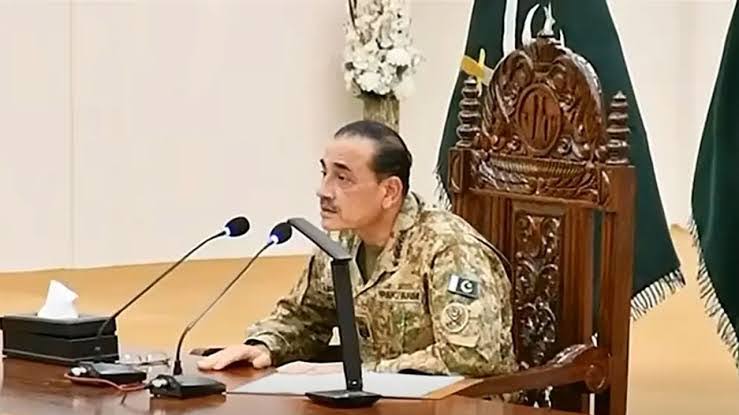
Field Marshal Asim Munir, Pakistan’s Chief of Defence Forces (CDF) and Chief of Army Staff (COAS), has vowed a forceful response against what Pakistan describes as India-backed terrorists, stressing that security forces will pursue militant groups wherever they operate.
The statement came during his visit to Corps Headquarters in Peshawar, where he reviewed the security situation, counter-terrorism operations and the preparedness of military formations deployed across Khyber Pakhtunkhwa (KP), according to the military’s media wing, Inter-Services Public Relations (ISPR), on Friday.
During the briefing, Munir received updates on border management measures and ongoing efforts to counter security threats in the province.
ISPR said the military chief praised the morale and professionalism of officers and soldiers. He also instructed the troops to maintain constant vigilance and the highest level of operational readiness to respond effectively to emerging threats.
Asim Munir Orders Continued Action Against India-Backed Terrorists
Reaffirming the military’s counter-terrorism commitment, Asim Munir said operations against groups that Pakistan identifies as India-sponsored militant organisations would continue with full force.
According to ISPR, he stressed that the armed forces would pursue these groups wherever they were found, underlining the military leadership’s determination to intensify efforts against terrorism.
Munir also paid tribute to the sacrifices made by the Pakistani people, particularly members of the security forces who have lost their lives or sustained injuries in the fight against militancy.
The military leadership expressed confidence that, with public support, Pakistan would defeat militant organisations and the ideology associated with them, ISPR stated.
Shehbaz Sharif Announces Rs160 Billion Development Package for KP
The military chief’s visit followed a meeting of the Federal Apex Committee chaired by Prime Minister Shehbaz Sharif at Governor’s House in Peshawar a day earlier. Senior civilian and military officials, including Munir, attended the meeting to discuss the province’s security challenges and development priorities.
Addressing the gathering, the prime minister said the federal government and military leadership were working together on an accelerated basis to establish lasting peace and support economic and social development in Khyber Pakhtunkhwa.
Shehbaz also announced a development package worth Rs160 billion for the province, signalling the government’s intention to combine security measures with development initiatives.
Commenting on the possibility of imposing governor’s rule and emergency measures in KP, the prime minister said the province’s worsening law and order situation had made difficult decisions necessary.
He reiterated that the federal government, working alongside the military leadership, was determined to restore stability and promote prosperity, particularly in districts severely affected by terrorism.
Pakistan Faces Rising Militant Attacks Along Its Borders
Pakistan has experienced a significant increase in cross-border militant violence, particularly in Khyber Pakhtunkhwa and Balochistan, since the Afghan Taliban returned to power in 2021.
The country recorded its highest monthly number of militant attacks in 12 years during September 2026, highlighting the growing security challenges confronting Pakistani authorities.
Islamabad has repeatedly called on Kabul to prevent militant organisations from using Afghan territory to launch attacks inside Pakistan. Pakistani authorities maintain that the Afghan Taliban government has not taken sufficient action against groups accused of targeting Pakistani security personnel and civilians.
The issue remains a major source of tension between the neighbouring countries, with Pakistan pressing for stronger action against militant networks operating from across the border.
Pakistan and Afghanistan Yet to Resolve Security Disputes
Despite several rounds of discussions, Pakistan and Afghanistan have been unable to reach a lasting agreement on the activities of militant groups allegedly operating from Afghan soil.
The dispute continues to complicate bilateral relations, as Islamabad seeks stronger assurances that Afghan territory will not be used to plan or carry out attacks inside Pakistan.
Against this backdrop, the latest remarks by Asim Munir underline the Pakistani military’s stated determination to maintain pressure on militant organisations while strengthening security arrangements in vulnerable areas.
The effectiveness of these efforts will remain closely tied to developments along the border, cooperation between Islamabad and Kabul, and the broader campaign to restore peace in terrorism-affected regions.