
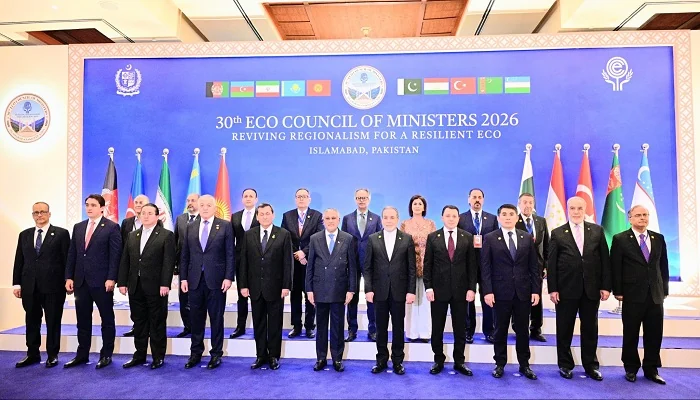
Member states of the Economic Cooperation Organisation (ECO) have backed Pakistan’s peace efforts to end the US-Iran war, supporting diplomatic initiatives by Pakistan, Qatar and Iran to achieve a lasting settlement.
The support came in the Islamabad Communiqué adopted on Monday at the conclusion of the 30th meeting of the ECO Council of Ministers. The member states welcomed mediation efforts by Pakistan and Qatar, along with Iran’s recent initiative to secure a dignified resolution and a complete end to the ongoing conflict.
The ministers expressed concern over the region’s challenging geopolitical situation and stressed the need for restraint, dialogue and diplomatic engagement. They also recognised Iran’s position as a founding member of the ECO and acknowledged its contributions to the organisation.
The communiqué praised Pakistan’s consistent diplomatic support for ECO member states and its efforts to reduce tensions during the recent Iran-US crisis.
It specifically highlighted the Islamabad Peace Talks, the Islamabad Memorandum of Understanding (MoU) and Pakistan’s participation in follow-up negotiations in Burgenstock, Switzerland.
The ministers also appreciated Qatar’s role as a trusted international mediator, particularly its diplomatic efforts during the 81st session of the United Nations General Assembly.
Reaffirming their commitment to dialogue, international law and mutual trust, the member states called for continued cooperation to promote peace and stability across the region.
The communiqué also opposed unilateral sanctions, coercive measures and economic pressure. It said their effects on international trade, finance and technology went against the principles of the United Nations Charter and international law.
Beyond diplomatic developments, the ECO meeting focused on strengthening economic cooperation, regional trade, infrastructure and institutional development.
The ministers welcomed the adoption of the Strategic Goals of Economic Cooperation 2035, describing them as a framework for greater regional integration, connectivity and sustainable development. They also looked to the 18th ECO Summit in Tehran to provide strategic guidance for implementing these goals.
On trade, the member states called for faster amendments and implementation of the ECO Trade Agreement (ECOTA). They urged greater participation to promote trade liberalisation and improve access to regional markets.
The communiqué also supported the establishment of joint trade zones, stronger cross-border business links, regional manufacturing and shared supply chains. It called for simpler customs procedures and greater use of e-commerce.
The ministers stressed the need to fully implement the ECO Transit Transport Framework Agreement to improve regional connectivity. They called for developing transport corridors, improving access to international seaports for landlocked countries, reducing transport costs and removing barriers to the movement of goods.
Energy security, clean energy, agriculture and industrial development also featured prominently in the discussions. The ministers welcomed the operationalisation of the ECO Clean Energy Centre in Baku.
They also called for stronger cooperation in artificial intelligence and other emerging technologies through joint research, training and capacity-building programmes.
On climate change, the member states stressed the importance of working together on water conservation, glacier protection, desertification and climate-resilient agriculture.
The communiqué also raised concerns over the humanitarian situation in Gaza following flooding in Deir al-Balah and nearby areas on November 6. It called for the urgent delivery of food, medicines, fuel, heating equipment, tents and winter clothing.
The ministers further called for an end to forced displacement and the deliberate deprivation of food. They also urged the full implementation of the Gaza ceasefire agreement reached in October 2025.
Pakistan assumed the ECO chairmanship for 2026-27 under the theme “Reviving Regionalism for a Resilient ECO”. Member states appreciated Pakistan’s arrangements for the meeting and praised Deputy Prime Minister and Foreign Minister Ishaq Dar for chairing the session.