
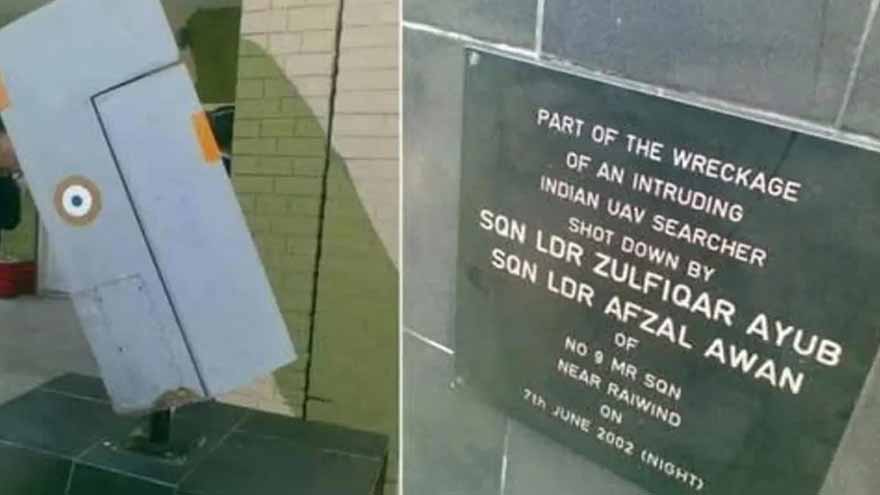
During the period of heightened tensions known as Operation Parakram, the Pakistan Air Force carried out a major air defence operation on June 7, 2002, after detecting a violation of Pakistani airspace near Lahore.
According to official accounts, an Indian Air Force Searcher Mk II reconnaissance drone—reportedly manufactured in Israel—entered Pakistani territory on a night surveillance mission. The drone was designed for low-altitude and low-speed flight, making it difficult to detect on radar.
Despite these challenges, PAF air defence systems successfully tracked the target. After confirmation of the intrusion, command authorities ordered an immediate interception.
An F-16 Fighting Falcon from No. 9 Squadron was scrambled for the mission, piloted by Squadron Leader Zulfiqar Ayub with Squadron Leader Afzal Awan serving as navigator. Ground radar controllers guided the aircraft toward the target in nighttime conditions.
Once visually identified, the F-16 fired an AIM-9L Sidewinder, which successfully destroyed the drone. The wreckage fell inside Pakistani territory and was later recovered by authorities.
Military analysts regard the operation as a significant milestone in Pakistan’s air defence capability, particularly because it involved detecting and engaging a small unmanned aircraft at night. The incident remains one of the notable episodes in PAF history during the broader India-Pakistan standoff.
While India has not formally confirmed operational details, the event continues to be cited in defence discussions as an example of effective aerial surveillance response during Operation Parakram.