
BEIJING: Pakistan China relations have entered a new phase of closer cooperation after both countries reached a broad consensus to further strengthen their strategic partnership and expand collaboration across multiple sectors.
According to a joint statement issued on Tuesday, both sides agreed to deepen Pakistan China relations by enhancing strategic coordination and promoting high-quality development under the upgraded China-Pakistan Economic Corridor (CPEC 2.0). They also welcomed the participation of third parties in selected development projects.
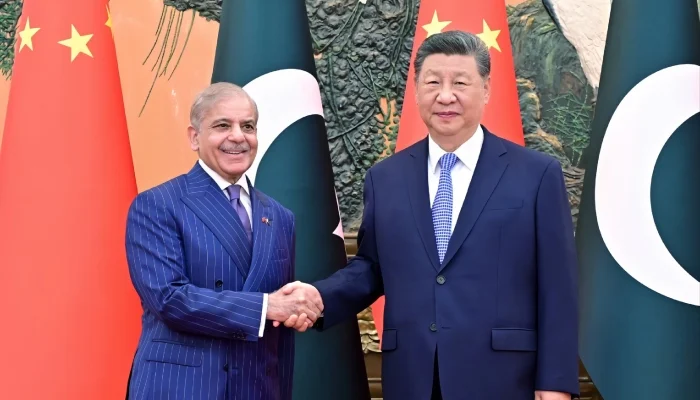
The announcement came after Prime Minister Shehbaz Sharif completed a four-day official visit to China at the invitation of Chinese Premier Li Qiang. During the visit, he met Chinese President Xi Jinping and held detailed discussions with Premier Li on bilateral, regional, and global issues.
Both sides described Pakistan China relations as a “strategic asset” built over decades of trust and cooperation. They reaffirmed that the partnership remains strong despite changing global and regional challenges.
The two countries also agreed to advance a closer China-Pakistan Community with a Shared Future and implement the 2025–2029 action plan aimed at further strengthening Pakistan China relations in political, economic, and security areas.
In the talks, both sides agreed to maintain high-level exchanges, improve political trust, expand practical cooperation, and enhance defence and security collaboration. They also committed to closer coordination on regional and international matters.
Pakistan reaffirmed its support for China’s global initiatives, including the Global Development Initiative, Global Security Initiative, Global Civilization Initiative, and Global Governance Initiative.
Security cooperation was also a key focus. Pakistan assured China of stronger security arrangements for Chinese nationals, projects, and institutions operating in the country. China, in return, expressed support for Pakistan’s efforts against terrorism.
Both sides called for stronger international counter-terrorism cooperation and opposed double standards or political bias in such efforts. They also agreed that no group, including TTP and ETIM, should be allowed to use any territory to threaten peace.
Pakistan China relations were further reinforced through mutual support on core issues. Pakistan reaffirmed its commitment to the One-China principle, while China reiterated support for Pakistan’s sovereignty, stability, and development.
On economic cooperation, both countries agreed to accelerate Belt and Road cooperation and upgrade CPEC 2.0. They also discussed major connectivity projects, including the Karakoram Highway upgrade, Gwadar Port development, and improved regional connectivity through Khunjerab Pass.
The statement also noted that third-party participation will be allowed in CPEC projects under mutually agreed terms, marking a significant step in expanding Pakistan China relations.
Both countries also supported cooperation in artificial intelligence governance and backed the proposal for a World Artificial Intelligence Cooperation Organisation.
In addition, they exchanged views on regional issues, including Kashmir, Afghanistan, and Middle East tensions. China appreciated Pakistan’s diplomatic efforts in facilitating regional dialogue and ceasefire initiatives.
The visit concluded with the signing of multiple cooperation agreements, further strengthening Pakistan China relations and marking the 75th anniversary of diplomatic ties between the two countries.