
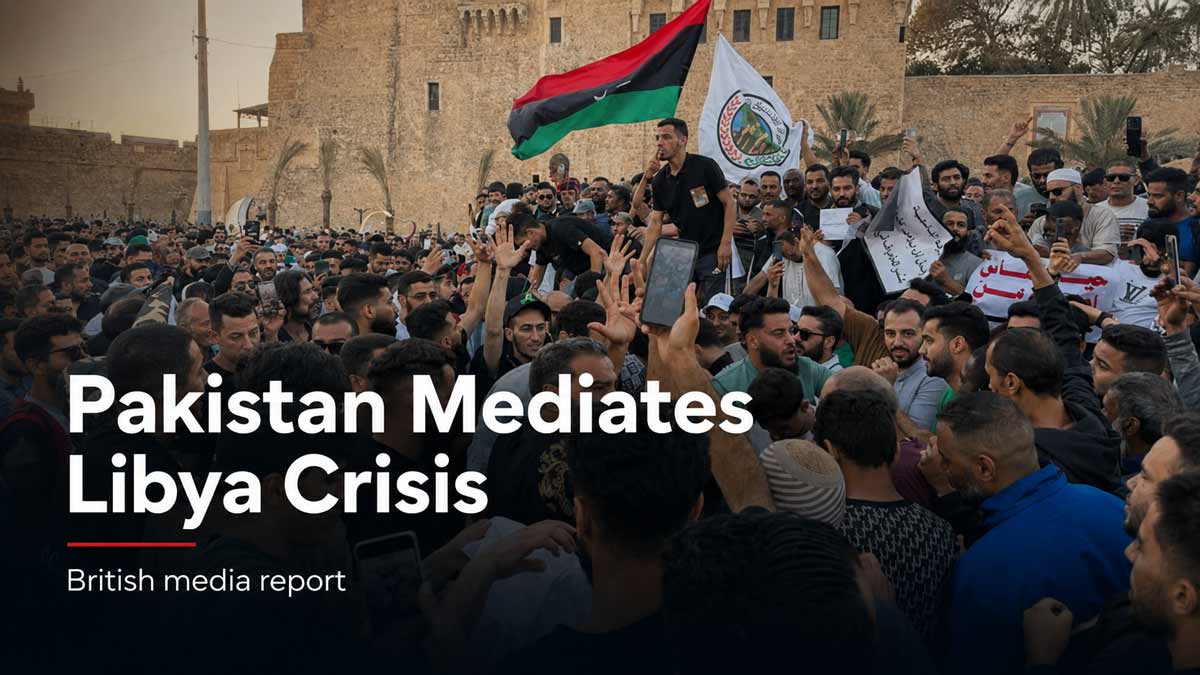
ISLAMABAD: Pakistan is playing a mediation role between Libya’s rival eastern and western factions in an effort to support a political settlement and reunification plan, according to a report by a British news agency citing two Pakistani sources.
The report said that, if successful, the diplomatic initiative could further strengthen Pakistan’s international role. The mediation effort comes as the United States has also been seeking a diplomatic solution to Libya’s prolonged political crisis.
Libya has remained divided between rival eastern and western administrations since the fall of Muammar Gaddafi’s government in 2011.
According to the Pakistani sources cited in the report, Islamabad’s mediation process began late last year. They said both rival Libyan sides had asked Pakistan to play a role in efforts to bridge their differences.
The sources further claimed that the United States was fully aware of and involved in the diplomatic process. Saudi Arabia was also supporting Pakistan’s mediation efforts, they added.
Pakistan has also played a role in diplomatic contacts between the United States and Iran this year, according to the report.
A summary of a proposed Libya reunification plan reviewed by the British news agency reportedly outlines a 36-month transitional power-sharing arrangement.
Under the proposal, a joint transitional structure would be established under the names Government of National Consensus and Presidential Council.
The plan reportedly proposes that Abdul Hamid Dbeibah, prime minister of Libya’s UN-backed western government, remain transitional prime minister.
Meanwhile, Saddam Haftar, deputy commander of the eastern-based Libyan National Army, would reportedly be appointed head of the Presidential Council.
According to the report, eastern Libyan forces led by Saddam Haftar’s father, Khalifa Haftar, control much of the country’s major oil resources and strategic facilities.
The proposed plan would also reportedly give the eastern side significant authority over budget-related matters.
One Pakistani source told the British news agency that Pakistan would play an active role in helping ensure continued implementation of any agreement reached between the rival sides.
However, the source added that further work was still required on the details of the proposed arrangement.
The report also referred to recent diplomatic contacts involving senior Pakistani and Libyan figures.
Last month, Field Marshal Asim Munir met Saddam Haftar in Rawalpindi. A few days later, Haftar travelled to Washington and met US Secretary of State Marco Rubio.
At the time, the US State Department said Rubio welcomed efforts by Libyan leaders to overcome their differences and reiterated US support for Libyan unity.
According to the British news agency, Pakistan’s Ministry of Foreign Affairs and the military’s media wing, Inter-Services Public Relations, did not immediately comment on the matter.
The report said there was also no immediate response from Libya’s eastern and western administrations or from relevant authorities in Qatar, Türkiye, Saudi Arabia and the United States.
Analysts cited in the broader discussion of the initiative note that Pakistan has a relatively limited role in Libya compared with countries such as the United States, the United Arab Emirates, Türkiye and Egypt.
However, Islamabad has maintained relations with both rival Libyan camps. That position may give Pakistan a diplomatic opening that some other regional countries do not have.
If the mediation succeeds, it could strengthen Pakistan’s diplomatic profile while contributing to international efforts aimed at ending Libya’s long-running political division.