
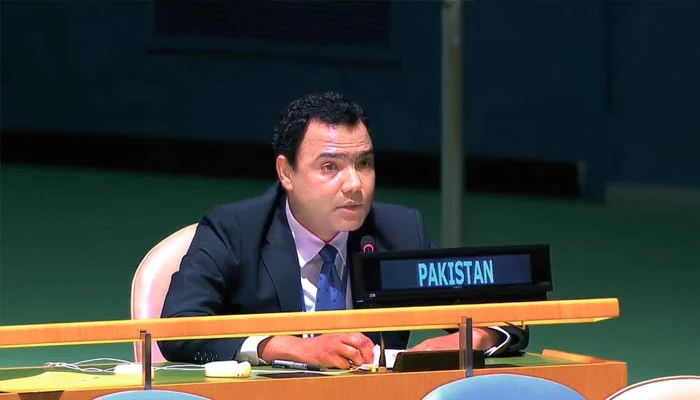
UNITED NATIONS: Pakistan raised the Kashmir issue at the UN General Assembly and firmly rejected India’s assertion that Jammu and Kashmir is an integral part of the country.
The remarks came during a diplomatic exchange at the United Nations after India’s Permanent Representative, Parvathaneni Harish, described Kashmir as an integral part of India.
Exercising Pakistan’s right of reply, Gul Qaiser Sarwani said Jammu and Kashmir remains an internationally recognised dispute that is still on the agenda of the UN Security Council.
He told the 193-member General Assembly that no attempt could change the historical, legal or international status of the dispute. He said Jammu and Kashmir “never was, neither is, and nor will ever be” an integral part of India.
The exchange followed a statement by Pakistan’s Permanent Representative to the UN, Asim Iftikhar Ahmad, who highlighted the continued relevance of the Kashmir and Palestine disputes during a discussion on the UN Security Council’s annual report.
Addressing the General Assembly, Ambassador Asim said the Security Council received more than 20 communications related to the India-Pakistan question during the reporting period from January to December 2025.
He noted that the Council also held closed consultations on the issue in May 2025, demonstrating that the Kashmir dispute continues to engage the attention of the Security Council more than seven decades after it was first placed on its agenda.
Ambassador Asim said lasting peace in South Asia requires a just resolution of the Kashmir dispute in line with relevant UN Security Council resolutions and the aspirations of the Kashmiri people. He reiterated Pakistan’s position that Kashmiris should be allowed to exercise their right to self-determination.
Speaking about Palestine, the Pakistani envoy said the humanitarian crisis, particularly in Gaza, remained a major concern for the Security Council. He welcomed the adoption of Resolution 2803, which endorses the Gaza Peace Plan, and stressed the need for its full implementation.
Pakistan, he added, remains committed to supporting the Palestinian people’s right to self-determination and the establishment of an independent and viable Palestinian state based on the pre-1967 borders, with Al-Quds Al-Sharif as its capital.
Ambassador Asim also highlighted the importance of UN peacekeeping operations and special political missions. He said Pakistan supports efforts to strengthen peace operations and ensure they remain effective, adequately resourced and capable of responding to emerging challenges.
He further called for a more democratic, representative and accountable multilateral system, saying concerns remain among member states over the continued use of the veto. According to Pakistan, expanding individual permanent memberships and veto powers would not serve the broader goals of reform and inclusivity within the United Nations.