
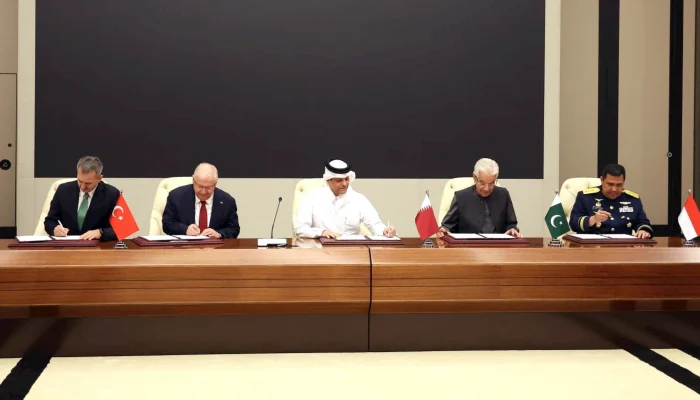
Pakistan, Türkiye, Qatar and Indonesia have signed a new defence cooperation agreement aimed at strengthening military capabilities, expanding defence production and improving collaboration among their respective defence industries.
The agreement, known as the Badr Memorandum of Understanding (MoU), was signed in Doha on Wednesday, according to Türkiye’s Defence Ministry. The deal reflects the four countries’ intention to deepen strategic ties and establish stronger partnerships in defence-related fields.
Under the agreement, the participating nations intend to expand cooperation in military manufacturing, technical training, research and development, while making greater use of their individual industrial and technological strengths.
Pakistan Turkey Defence Deal Focuses on Joint Military Production
The Badr agreement is designed to improve coordination between the four countries’ defence industries and strengthen their ability to develop and produce military equipment.
Türkiye’s Defence Ministry said the initiative would help participating nations combine their manufacturing capabilities, enhance industrial capacity and address the defence requirements of allied and friendly countries.
The agreement also places emphasis on technical cooperation, military training and research and development, creating opportunities for the countries to share expertise and build stronger domestic defence industries.
For Pakistan, the Pakistan Turkey defence deal offers another opportunity to explore joint production, technology transfer and greater self-reliance through cooperation with established international partners.
Türkiye Strengthens Defence Ties With Gulf and Asian Partners
Türkiye has developed a substantial defence industry and maintains NATO’s second-largest military, making it an important partner for countries seeking to strengthen their defence capabilities.
Ankara has also expanded its security engagement with Gulf nations, including Qatar, where Türkiye maintains a military base. These relationships have gained additional significance amid regional tensions linked to the US-Israeli war against Iran.
Türkiye’s defence partnerships extend beyond the Gulf. In August, Ankara signed a mutual defence pact with Pakistan and Saudi Arabia under which an attack on one participant constitutes an attack on all, according to the report.
Indonesia has also maintained close ties with Türkiye, particularly in the defence industry, providing another avenue for cooperation under the new four-country agreement.
The Badr MoU is expected to build on these existing relationships by encouraging industrial collaboration and supporting shared security objectives.
Pakistan Highlights Technology Transfer and Defence Self-Reliance
Pakistan has welcomed the agreement as an opportunity to deepen cooperation with trusted international partners.
In a subsequent statement, Defence Minister Khawaja Asif said Islamabad attaches considerable importance to strengthening defence relationships and views the memorandum as a contribution to regional peace and stability.
He said Pakistan would seek opportunities for greater industrial collaboration, joint production, technology transfer and improved self-reliance by drawing on the complementary strengths of the participating countries’ defence industries.
Asif also highlighted the potential for cooperation in joint research and development, training exchanges and the expansion of industrial capabilities.
He added that these activities would be pursued in accordance with applicable domestic and international laws and regulations.
Badr Agreement Aims to Strengthen Regional Security Cooperation
The four-country agreement establishes a framework for closer coordination in defence manufacturing, military training and technological development.
By combining their respective capabilities, Pakistan, Türkiye, Qatar and Indonesia aim to strengthen their defence industries and create opportunities for longer-term cooperation.
The extent of future collaboration will depend on how the countries translate the memorandum into practical projects, including joint manufacturing initiatives, research programmes and technology-sharing arrangements.
For Pakistan, the agreement adds another dimension to its defence partnerships while placing industrial development and technological self-reliance among the key areas of potential cooperation.