
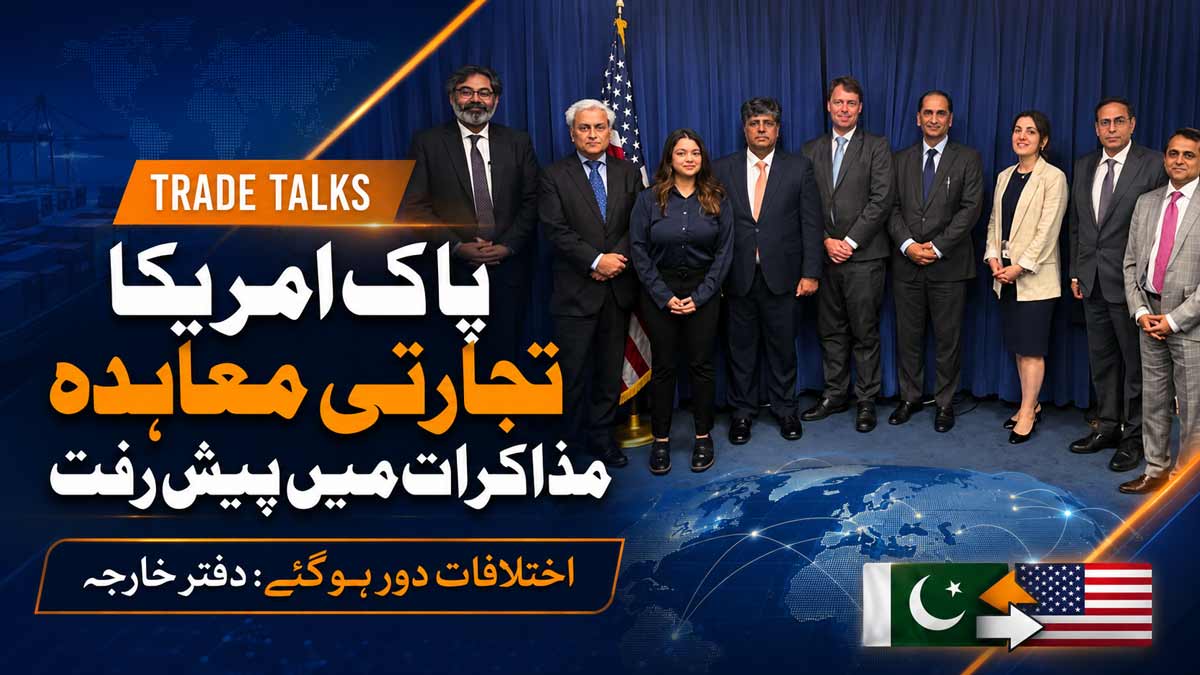
ISLAMABAD: Pakistan and the United States have made progress toward a reciprocal trade agreement after talks in Washington, Pakistan’s Foreign Office said on Saturday.
Foreign Office spokesperson Tahir Andrabi said the talks were held in a cordial atmosphere. He said both sides had removed differences and built convergence to help finalize the agreement at an early stage.
The talks came as a temporary 10 percent US tariff imposed under Section 122 of the Trade Act of 1974 is set to expire later this month. Both countries are trying to replace temporary trade measures with a more stable bilateral framework.
Pakistan is seeking lower duties on exports to the United States, which is its largest single-country export market, according to Arab News.
The negotiations were held in Washington on Thursday and Friday. Pakistan’s delegation was led by Commerce Secretary Jawad Paul, while senior officials from other ministries also participated.
According to Radio Pakistan, the talks aimed to strengthen Pakistan-US trade relations, facilitate bilateral trade and expand existing economic cooperation.
The latest round of talks focused on a proposed Pakistan-US Agreement on Reciprocal Trade.
Andrabi said Commerce Secretary Jawad Paul described the negotiations as positive and appreciated the significant progress made during the talks.
The discussions followed more than a year of changing US trade measures and legal challenges that affected the tariff outlook for Pakistani exports.
The trade dispute began in April last year when US President Donald Trump invoked the International Emergency Economic Powers Act to impose a 29 percent tariff on Pakistani exports as part of a wider package of global trade measures.
After talks between Pakistani officials and the Office of the United States Trade Representative, the proposed tariff on Pakistani goods was reduced to 19 percent.
However, that arrangement was disrupted in February after the US Supreme Court ruled that the White House had exceeded its constitutional authority by imposing broad tariffs under the IEEPA.
After the court ruling, the Trump administration invoked Section 122 of the Trade Act of 1974 to impose a temporary 10 percent global tariff for up to 150 days.
The White House notice said the surcharge took effect on February 24, 2026, and would remain in effect until July 24, 2026, unless suspended, modified or extended by Congress.
Separately, the USTR proposed another tariff measure after a Section 301 investigation linked to forced labor standards and import restrictions. Pakistan submitted legal and regulatory documents challenging the proposed measure before the talks.
The progress in talks could help Pakistan and the United States move toward a more predictable trade framework.
For Pakistan, lower export duties would be important for sectors that depend on access to the US market. For Washington, a reciprocal trade arrangement could create a clearer structure for bilateral economic cooperation.
Officials have not yet announced a final agreement. However, the Foreign Office statement suggests that both sides are now closer to resolving outstanding issues and moving toward an early conclusion of the trade deal.