
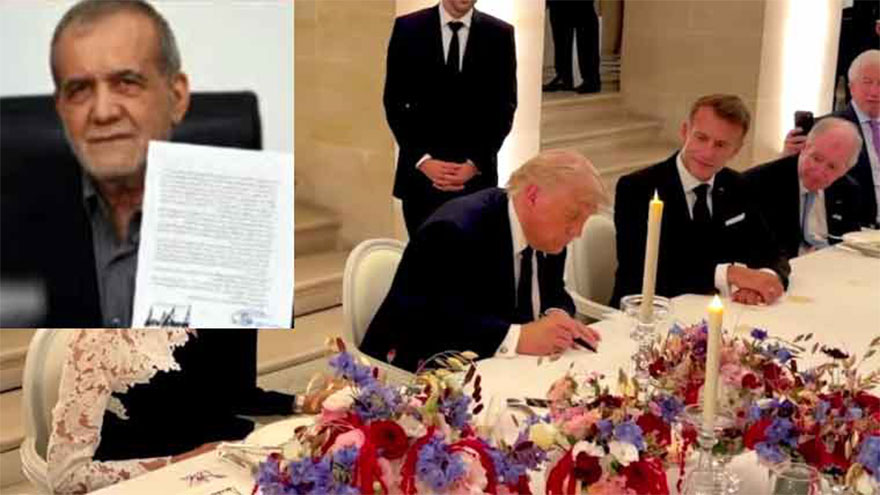
US President Donald Trump and Iranian President Masoud Pezeshkian have signed a US-Iran peace deal aimed at ending months of conflict and opening the door to broader negotiations on Tehran’s nuclear program.
The agreement was signed following the G7 summit in France. Officials from both countries confirmed that the document had been finalized and would take effect immediately.
Under the deal, Iran will reopen the Strait of Hormuz, one of the world’s most important shipping routes, while the United States will lift its naval blockade around Iranian ports. The move is expected to restore trade flows and ease tensions across the region.
The agreement also includes immediate relief from US oil sanctions that have weighed heavily on Iran’s economy. In addition, Washington has pledged to support the release of a $300 billion reconstruction fund backed by regional countries once a final agreement is reached on Iran’s nuclear program.
The conflict began on February 28 when the United States and Israel launched military operations against Iran. Tehran responded with missile and drone attacks across the region, leading to major disruptions in shipping and trade.
Iranian officials described the agreement as evidence that their country had resisted external pressure. Iranian Parliament Speaker Mohammad Bagher Ghalibaf said the public would judge the outcome of the deal.
The agreement marks the beginning of a two-month negotiation period focused on long-term arrangements for Iran’s nuclear activities. According to the published terms, Iran will dilute its stockpile of enriched uranium under the supervision of the International Atomic Energy Agency (IAEA).
US officials said the agreement does not require Washington to provide direct financial contributions. However, the easing of sanctions and the prospect of reconstruction funding could provide significant economic benefits for Iran.
The deal has generated mixed reactions in the United States. While supporters view it as a step toward regional stability, some critics argue that it does not adequately address Iran’s nuclear ambitions.
Republican Senator Bill Cassidy criticized the agreement, claiming it rewards Iran without securing meaningful restrictions on its nuclear program. He described the arrangement as a major foreign policy mistake.
Meanwhile, Hezbollah leader Naim Qassem welcomed the agreement and called it a victory for Iran. He also praised Tehran for ensuring that Lebanon was included in the ceasefire arrangements.
The reopening of the Strait of Hormuz is expected to be the first major test of the agreement. Energy markets have closely followed developments, with oil prices fluctuating as uncertainty over the deal’s implementation continued.
Although violence has decreased in parts of the region since the announcement, tensions remain. Israeli military operations in southern Lebanon have continued, and both sides have reported new security incidents in recent days.
Diplomats now face the challenge of turning the temporary agreement into a long-term settlement that addresses regional security concerns and Iran’s nuclear program while preventing a return to conflict.