
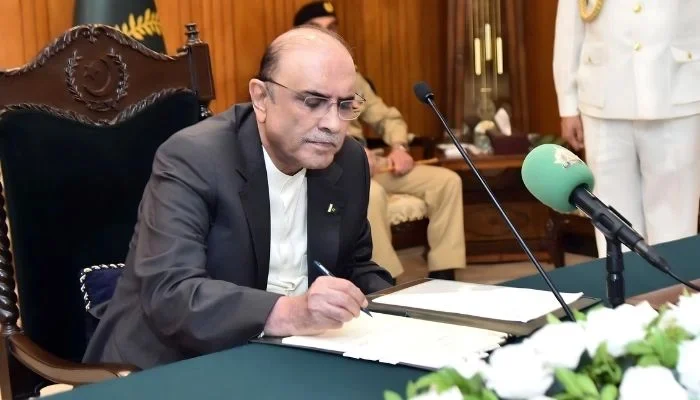
ISLAMABAD: President Asif Ali Zardari on Sunday declared an emergency and imposed governor’s rule in Khyber Pakhtunkhwa, acting on advice from Prime Minister Shehbaz Sharif. The move was justified by the province’s deteriorating security situation.
The President’s Secretariat said in a press release that Zardari approved and signed the summary under Articles 232 and 234 of the Constitution of Pakistan, following the prime minister’s advice.
What Led to the Decision
According to the statement, the step followed recommendations from the federal cabinet, the prime minister’s formal advice and law-and-order reports submitted by relevant security institutions. It also pointed to the collapse of talks between a government delegation and the provincial leadership over the security situation.
The federal government had accused the provincial administration of falling short in its counterterrorism efforts, and cited this as grounds for the decision. Under the Constitution, the federal government can make special arrangements during an emergency, including suspending certain provisions that relate to provincial bodies or authorities.
How Governor’s Rule Will Work in Khyber Pakhtunkhwa
Speaking at a news conference in Islamabad, Law Minister Azam Nazeer Tarar said KP Governor Faisal Karim Kundi will take charge, supported by an 11-member advisory council. He said the arrangement will initially remain in place for six months.
Political Tensions Behind the Khyber Pakhtunkhwa Emergency
The announcement comes at a time of rising political friction. Chief Minister Sohail Afridi has been leading a long march that began in Lakki Marwat on October 4, after negotiations between the government and the opposition failed to produce an agreement.
The talks stalled over two issues: counterterrorism cooperation in the province, and access to jailed PTI founder Imran Khan, including a meeting with his personal doctor. Both sides blamed each other for the breakdown while Afridi kept leading the march through the province.
Governor Kundi Welcomes the Proclamation
Soon after the announcement, Governor Kundi said in a video message that the people of the province welcomed the presidential proclamation. He said residents want peace, stability, development and prosperity rather than unrest and insecurity.
Kundi said the province’s peace-loving people do not support terrorism or violence. He said they had resolved not to back Fitna al-Khawarij and would stand shoulder to shoulder with the security forces against terrorists until their last breath.
He also said residents hope for brotherly relations and mutual cooperation with other provinces. He urged people to keep the peace and avoid breaking the law, inciting violence or rioting, and warned that action would be taken against anyone who disturbed law and order or took the law into their own hands.
Fazlur Rehman Calls It an “Attack on Democracy”
Reacting separately, Jamiat Ulema-e-Islam-Fazl (JUI-F) chief Maulana Fazlur Rehman described the emergency and governor’s rule as an “attack on democracy.” He said his party would reach out to the public and continue to play its role both inside and outside parliament.
At a press conference, Fazlur Rehman said the government wanted the long march declared over before it would accept the protesters’ demands. He added that PTI had asked for permission to meet its founder, Imran Khan.
The JUI-F chief said he had held discussions with Sohail Afridi, Barrister Gohar Ali Khan, Shahram Khan Tarakai and Asad Qaiser about the situation. According to him, PTI representatives had said they were ready to call off the long march if their demands were accepted.
Pakistan Army Deployed in KP
The federal government has also approved the deployment of the Pakistan Army in Khyber Pakhtunkhwa under Article 245 of the Constitution, according to a notification.
The army will assist the administration, protect citizens’ lives and safeguard public property and government installations. The deployment will last for the duration of the emergency imposed on October 11. The KP governor will decide the number of troops in consultation with GHQ and the Military Operations Directorate, the notification said.