
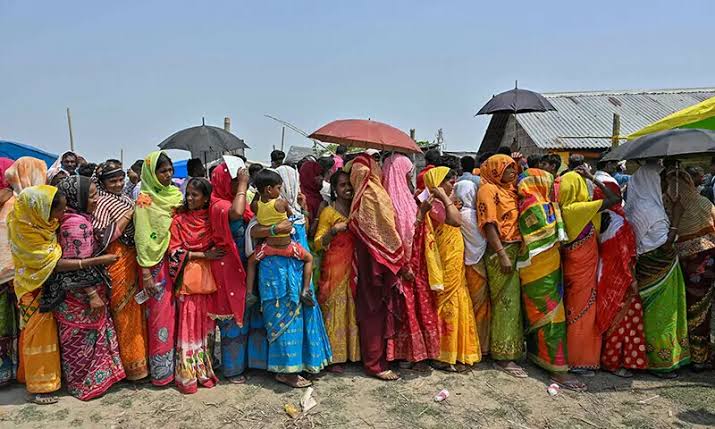
A major voter list revision in India has raised concerns over the exclusion of Muslim citizens, with a US religious freedom panel accusing the government of targeting religious minorities.
The revision removed around 130 million names from voter lists across the country, marking the largest deletion of voters in India’s history. The number is roughly equivalent to Mexico’s population.
Asif Mahmood, chair of the US Commission on International Religious Freedom (USCIRF), said the Indian government was targeting Muslim citizens by removing their names from voter rolls, labelling them foreigners and deporting them.
Data suggests that the deletions disproportionately affect Muslims, India’s largest religious minority. Rights groups have repeatedly raised concerns about discrimination against Muslims since Prime Minister Narendra Modi’s Bharatiya Janata Party (BJP) came to power in 2014.
India’s Election Commission, however, says the revision aims to remove duplicate, deceased, relocated and otherwise ineligible voters. It maintains that people whose names have been wrongly deleted can appeal the decision.
The controversy has become more serious because of a parallel government campaign to identify and deport suspected illegal immigrants. However, removal from voter lists does not automatically establish that an individual is a foreign national.
Gene Mills, another USCIRF commissioner, described the alleged deportation of Indian citizens on the basis of their Muslim faith as a serious escalation in the treatment of religious minorities.
He urged the US State Department to designate India as a “Country of Particular Concern” over religious freedom.
The USCIRF is a bipartisan US government body that monitors religious freedom worldwide and makes policy recommendations. Its recommendations are not legally binding, and Washington has not acted on its recent calls for action against India.
India’s Foreign Ministry has rejected the commission’s criticism, accusing it of bias and interference in the country’s internal affairs. The Indian Embassy in Washington did not respond to a request for comment.
The voter list revision has also triggered protests in recent weeks. Opposition parties and student groups allege that the changes disproportionately affect people unlikely to support the ruling BJP. Human rights experts have also criticised the government’s handling of the demonstrations.
US Secretary of State Marco Rubio described the issue last month as a domestic political matter and said Washington would not comment on it.
UN experts and human rights organisations have also expressed concern over the treatment of religious minorities under Modi’s government.
Their concerns include rising hate speech, a religion-based citizenship law that the UN has described as fundamentally discriminatory, the demolition of Muslim-owned properties, the removal of Indian-administered Kashmir’s special status and anti-conversion laws.
The Indian government denies discriminating against religious minorities. It maintains that its policies, including food subsidy programmes and rural electrification initiatives, benefit people across all communities.
Civil rights advocates have also raised concerns about the treatment of Muslims in the United States. They point to growing Islamophobia and increasingly anti-Muslim rhetoric among some Republican politicians during election campaigns.