
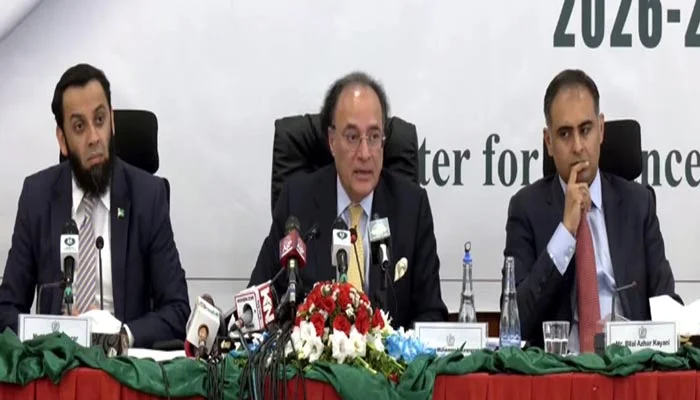
Finance Minister Muhammad Aurangzeb said on Saturday that Pakistan’s economy is now moving from stabilisation towards growth as the government presented key details of the federal budget for the 2026–27 fiscal year. He said Pakistan’s economy is heading in the right direction and the next phase will focus on strengthening growth through exports and structural reforms.
Speaking at a post-budget press conference, the finance minister said the government has worked on improving both tax collection and export performance. He added that the budget reflects a clear shift in strategy, with export-led growth at its core. According to him, Pakistan’s economy has already shown improvement during the outgoing fiscal year, and the available fiscal space has been used carefully to support recovery and stability.
Aurangzeb said the government is now focusing on creating an enabling environment for exporters. He announced additional subsidies of Rs70 billion to help exporters access financing at a reduced rate of 4.5%, aiming to improve competitiveness and liquidity in the export sector.
He also confirmed that the super tax has been abolished for businesses earning more than Rs500 million. He described it as a major step toward encouraging investment and production. He further said that advance tax has also been removed to support export-led activity and industrial growth.
The finance minister said these measures are part of a broader policy direction to shift Pakistan’s economy toward sustainable growth by supporting industries that contribute to exports, increasing documentation, and reducing unnecessary tax burdens.
He highlighted ongoing reforms in the tax system, saying the government is moving toward a modern, technology-driven model. This system will rely on automation and artificial intelligence to reduce human intervention and improve transparency and efficiency in tax collection.
In the agriculture sector, he said all duties on imported agricultural machinery have been reduced to zero to support modernization. He added that agricultural credit has increased by 15 percent and now exceeds Rs2 trillion. He also assured small farmers that they will not be required to mortgage their homes to access financial support.
Relief measures were also announced for salaried individuals, with the lowest tax slab reduced from 5 percent to 1 percent. He said the government has focused on easing the burden on low-income earners while adjusting other income brackets to create a fairer tax structure.
The minister added that the construction sector has also been supported through reduced taxes, while the IT and freelancer tax regime has been kept stable to ensure continuity.
Aurangzeb said Pakistan’s economy faces challenges from global energy pressures, but the government has built fiscal buffers to manage external shocks. He noted that rising oil prices had previously increased import costs, but coordinated efforts helped reduce the impact.
He also said the government is encouraging Public-Private Partnership models for development projects to ensure better use of resources. He added that future development spending will focus on projects with commercial viability.
According to him, Pakistan’s economy has enough resources for development, but efficient management and private sector participation will be key to long-term growth.
Minister of State for Finance Bilal Azhar Kayani also said the budget is aimed at reducing the economic burden on citizens while supporting industry, exports, and employment. He said the export-led strategy will benefit workers across the entire production chain, not just exporters.
He added that development projects in education, health, and housing have been included in the Public Sector Development Programme to support underserved regions and improve social outcomes.