
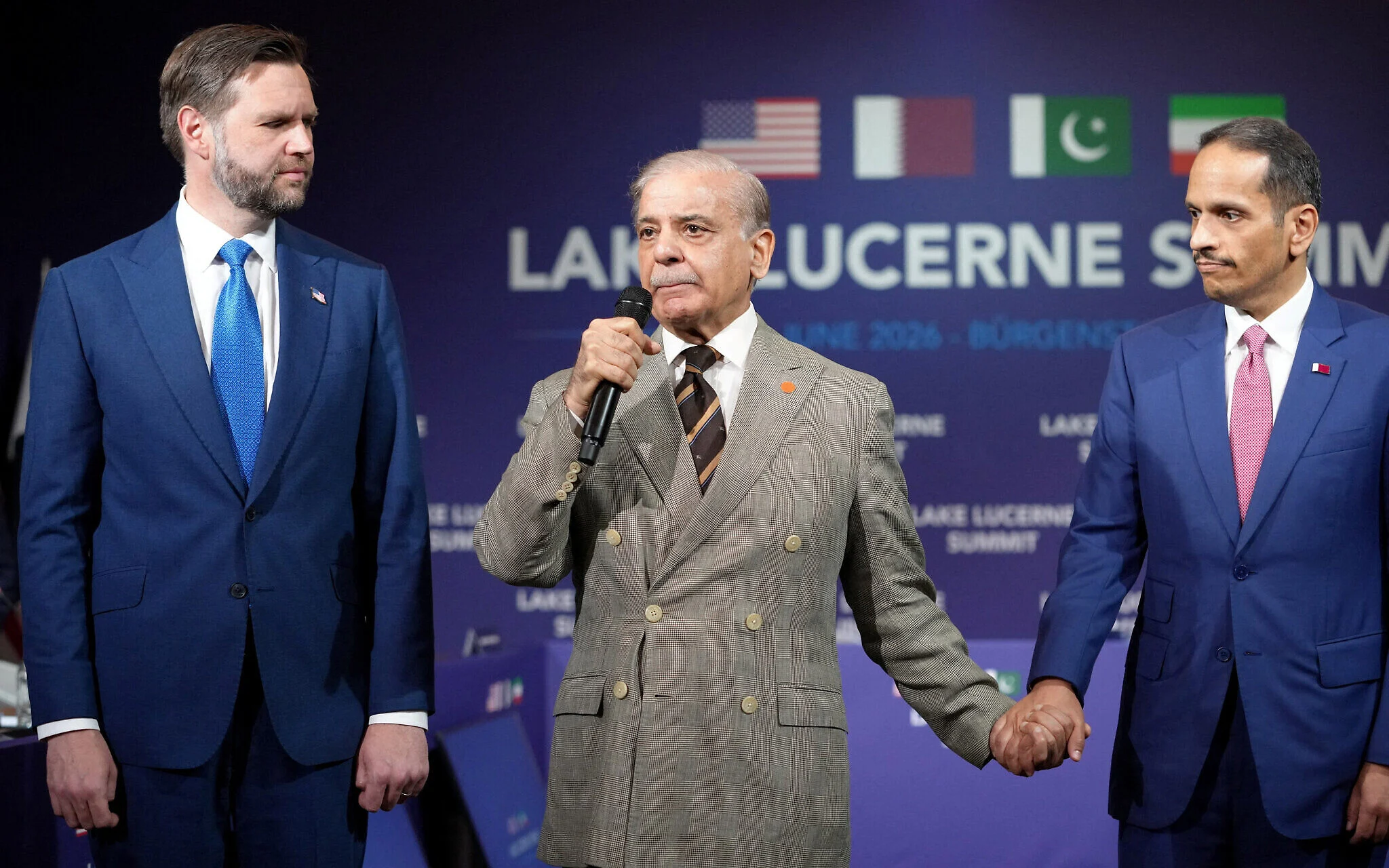
BUERGENSTOCK: The first round of US-Iran talks in Switzerland ended on Monday after senior officials from both countries agreed on a roadmap aimed at reaching a final agreement within 60 days.
A joint statement issued by mediators Pakistan and Qatar said technical discussions would continue throughout the week at the Qatari-owned resort in Buergenstock, Switzerland. The statement added that both sides had also agreed on a mechanism to end fighting in Lebanon and establish a communication channel to ensure safe passage for commercial vessels through the Strait of Hormuz.
US Vice President JD Vance and Iranian officials began negotiations on Sunday under a memorandum of understanding reached last week that extended a fragile ceasefire for another 60 days. The talks continued into the early hours of Monday.
Iranian Foreign Minister Abbas Araghchi said on social media that Iran had secured waivers for oil and petrochemical exports, the release of some frozen assets, and the launch of a reconstruction and development plan.
The White House did not immediately comment on the outcome of the talks.
Tensions remained high during the negotiations. Shortly before discussions began, President Donald Trump warned Iran against closing the Strait of Hormuz again, saying the country would face severe consequences if it did so. He also repeated earlier remarks about possible US control of the strategic waterway.
Trump said he supported last week’s agreement to prevent a global economic crisis caused by soaring oil prices following the strait’s closure. Oil prices have fallen significantly in recent days, with Brent crude dropping more than $1 to $79.44 per barrel after the joint statement was released.
Reports about the negotiations differed. Iran’s semi-official Tasnim news agency said Iranian delegates refused to return to formal talks after Trump’s comments became public, although messages continued through Pakistani and Qatari mediators.
However, a US diplomat involved in the negotiations told Reuters that Iranian officials remained engaged throughout the night. According to the diplomat, discussions covered the Strait of Hormuz, Lebanon, nuclear issues, and implementation details of the memorandum.
The agreement seeks to reopen the Strait of Hormuz, a vital route for global energy supplies, and end hostilities across the region, including in Lebanon.
Iran said over the weekend that it had again halted maritime traffic through the strait, arguing that the United States had failed to fulfil commitments related to ending violence in Lebanon. Tehran also stated that Sunday’s talks would not address substantive nuclear issues.
During the negotiations, Vance downplayed ongoing violence in Lebanon and said progress had been made toward ending hostilities.
Back in Washington, Trump warned that the United States could resume military action if Iran failed to restrain its regional allies, particularly Hezbollah.
Despite the tensions, Vance said President Trump wanted to “turn over a new leaf” and improve relations with the Iranian people.
Iran linked its latest closure of the Strait of Hormuz to continued fighting in Lebanon. Although a new ceasefire was announced on Friday, clashes have persisted. Data from analytics firm Kpler showed that only five vessels passed through the strait on Sunday, compared with 26 a day earlier.
In Lebanon, violence appeared to ease on Sunday. Residents in southern areas began returning home, and traffic increased in several regions following the ceasefire agreement.