
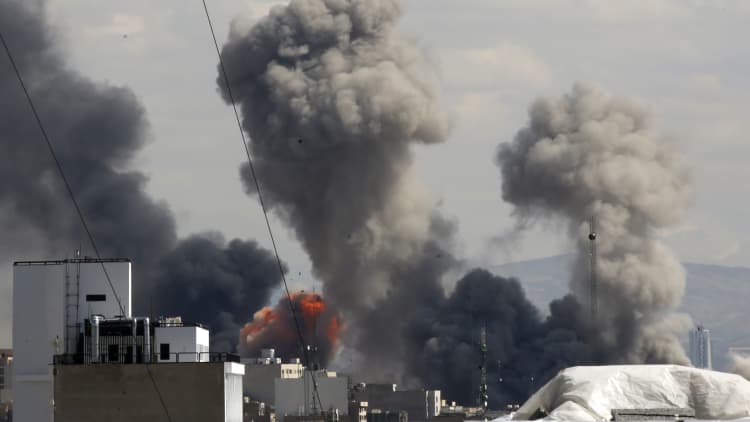
New US strikes set off air defence systems across Tehran on Wednesday, coming shortly after President Donald Trump declared he was “not finished” with a conflict against Iran that has already drained $37.5 billion from US coffers.
The clash between the two longtime adversaries, which had spread to the Strait of Hormuz and derailed an earlier tentative agreement, has now widened to touch another critical global oil chokepoint in the region.
Diplomatic Efforts Continue Despite Strikes
Even so, Secretary of State Marco Rubio maintained that Washington remains open to a diplomatic resolution with Tehran. Speaking at a Southeast Asian foreign ministers’ gathering in Manila, Rubio said the core issue is that Iranian negotiators are not taking the negotiations seriously.
Iran’s foreign ministry spokesperson, Esmaeil Baghaei, indicated that indirect communication with Washington through intermediaries was still ongoing.
The newest wave of strikes saw US forces target what officials described as military logistics infrastructure, while Iranian state media reported explosions in multiple locations, including near Bushehr, home to the country’s nuclear power facility. State television, posting on Telegram, noted that air defence activity had been detected in the western, eastern, and northeastern parts of Tehran.
Political Pressure Mounts as Costs Climb
With the war approaching its fifth month and November’s legislative elections drawing closer, Trump has come under growing political pressure, including from parts of his own base, to bring the fighting to an end. Pentagon chief Pete Hegseth confirmed Tuesday that the war’s price tag has reached $37.5 billion, a figure he cited while pushing for an additional multi-billion-dollar defence funding request.
The US military reported Tuesday that it had carried out its eleventh straight night of strikes on Iranian targets, aiming to weaken Tehran’s capacity to threaten commercial vessels moving through the Strait of Hormuz.
Trump also suggested that the next American target might be Pickaxe Mountain, an underground facility near Natanz that Western intelligence agencies believe houses an undeclared uranium enrichment site.
Iran Threatens Retaliation Amid Widening Conflict
Iran’s Khatam Al-Anbiya military command warned that striking the underground site would be treated as a war expansion, vowing retaliation against American interests and its allies, according to state broadcaster IRIB. The threat surfaced as Tehran extended its strikes against US-allied Gulf nations, following warnings from its Houthi allies that they might blockade Saudi ports.
Roughly two weeks after hostilities resumed between the two nations, Trump predicted Iran would need decades to recover from the destruction caused by the war, estimating a rebuilding timeline of 20 to 25 years if the US withdrew immediately. He added that American forces were staying put for now.
Houthi Threat Adds to Regional Tensions
Kuwait’s military said Wednesday its air defence systems were responding to drone strikes originating from Iran, part of Tehran’s latest retaliatory actions. Bahrain reported intercepting Iranian attacks on Tuesday amid repeated air raid sirens, while both Kuwait and Jordan confirmed intercepting missile and drone strikes of their own.
Iran’s armed forces said they had struck US assets stationed in Kuwait and Bahrain, including air defence systems, radar sites, and administrative facilities. The Revolutionary Guards cautioned that further, more intense waves of drone and missile attacks should be expected following the radar operation.
Trump warned he would respond forcefully if Yemen’s Houthi rebels carried out a threat made Monday to blockade Saudi Arabian ports, though how such a blockade would actually be enforced remains uncertain.
Maritime intelligence firm Vanguard Tech reported that a Singapore-flagged tanker and a Liberia-flagged tanker both reversed direction in the Red Sea shortly after taking on crude oil at Saudi Arabia’s Yanbu port. Should the Houthis act on their threat, it could disrupt Saudi Arabia’s ability to route oil exports around the Strait of Hormuz, with significant consequences for the global economy.
Saudi Arabia and the Houthis exchanged fire last week for the first time in years, putting a 2022 truce at risk, though the group had largely stayed out of the fighting since Israel and the US launched attacks on Iran in late February.
Iran’s Revolutionary Guards said Tuesday that two tankers attempting to pass through the strait were struck by explosions, causing major fires and leaving them stranded. Separately, the UK Maritime Trade Operations agency reported that an unidentified projectile had struck a tanker off the coast of Oman.
As the US Iran war strikes continue to intensify across multiple fronts, both sides appear locked in a standoff with no clear resolution in sight, even as diplomatic channels remain nominally open.