
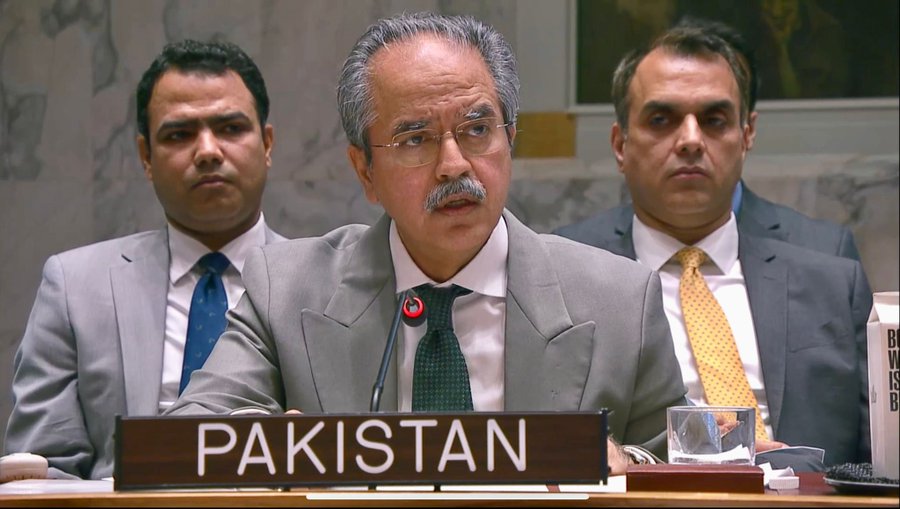
Pakistan has urged Yemen’s Houthi movement to halt its attacks on merchant vessels and sailors passing through the Bab al-Mandab strait, denouncing what it described as an attempt to turn the critical waterway into a weapon of conflict.
The appeal came during a UN Security Council Arria-Formula meeting, where Pakistan’s Permanent Representative to the UN, Ambassador Asim Iftikhar Ahmad, underlined the importance of safeguarding freedom of navigation and protecting commercial shipping operations in the region.
Houthi Offensive Puts Bab al-Mandab Strait Under Pressure
The warning follows a rapid offensive launched this month by the Houthis to seize control of Yemen’s entire Red Sea coastline, a move that has handed the group command over the strategically vital Bab al-Mandab passage. In the wake of this advance, the group announced a maritime blockade targeting Saudi Arabia, striking both Saudi-linked vessels in the Red Sea and locations inside the kingdom itself.
Addressing the council, Ambassador Ahmad pointed to the twin disruptions, the Bab al-Mandab attacks and separate turbulence in the Strait of Hormuz, as evidence that maritime instability can ripple outward, threatening not just regional security but global peace, energy markets and food supply chains.
“Pakistan strongly condemns the nefarious designs of Houthi militia to weaponise Bab al-Mandab by launching attacks on merchant shipping and innocent seafarers navigating the strait,” the ambassador said.
He reaffirmed Islamabad’s support for Riyadh, noting that the Houthi strikes seriously undermine maritime security and threaten the peace and development of countries across the region. Such actions, he warned, carry the risk of dire consequences for regional stability if left unchecked.
Concerns Extend to the Strait of Hormuz
Ambassador Ahmad also turned his attention to Hormuz, expressing Pakistan’s unease over ongoing attacks and disruptions affecting commercial vessels there. He called for immediate de-escalation, guarantees for the safety of ships and crew, and a return to normal passage through the strait, describing it as an indispensable trade corridor whose disruption carries serious consequences for global energy and fertiliser supplies.
As a littoral state bordering the Indian Ocean and a signatory to the UN Convention on the Law of the Sea, Pakistan places what the ambassador called paramount importance on maritime safety. “It is our principled position that global shipping should not become a casualty of conflict and strife. Instead, it should remain a driver of global trade and economy,” he said.
The envoy also highlighted Pakistan’s diplomatic role following the outbreak of hostilities between Iran and the United States on February 28, crediting Islamabad’s mediation efforts with helping secure a ceasefire and the subsequent Islamabad Memorandum of Understanding. He said Pakistan remains committed to pursuing a negotiated settlement of all unresolved issues to restore normalcy at sea and on land.
Looking ahead, Ambassador Ahmad said Islamabad would continue coordinating with regional and international partners to strengthen maritime peace and security, while working to protect commercial shipping and merchant vessels operating in the region.