
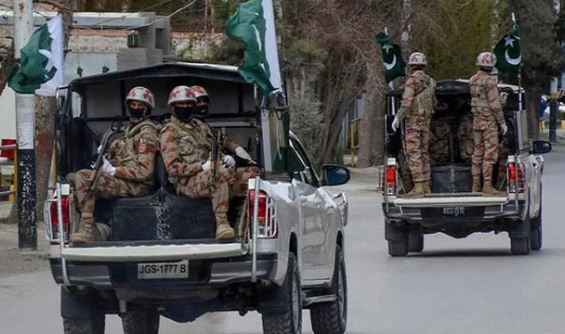
Pakistani security forces eliminated 10 Khyber Pakhtunkhwa militants tied to the India-backed Fitna al-Khawarij network during a series of clashes spanning September 15 to 17, the military’s media wing announced Thursday. The operations came at a cost, however, with six soldiers losing their lives in a roadside bomb attack.
The Inter-Services Public Relations (ISPR) said the first operation was launched in North Waziristan district after intelligence reports flagged militant activity in the area. Troops moved in and engaged the fighters directly, resulting in a fierce firefight that left six Fitna al-Khawarij members dead.
Second Clash in Hangu Adds to Militant Losses
A separate confrontation unfolded in Hangu district, where security personnel killed four additional militants. Combined with the North Waziristan operation, this pushed the total number of terrorists neutralized to 10 across the two-day span.
According to the ISPR statement, troops recovered weapons and ammunition from the slain fighters, who the military said had a documented history of involvement in terrorist activity throughout the region.
The successes came alongside a heavy loss. On September 17, an improvised explosive device detonated on a military convoy, killing six soldiers, the ISPR confirmed. Forces have since launched sanitization sweeps across both districts to root out any remaining militants who might still be hiding in the area.
Operations Tied to Broader National Strategy
Officials reiterated that these actions fall under the Azm-e-Istehkam framework, a counter-terrorism vision endorsed by the Federal Apex Committee as part of the National Action Plan. The military stressed that this campaign, aimed at purging foreign-backed terrorism from Pakistani soil, would proceed without pause.
The ISPR also honored the fallen soldiers, stating their sacrifice strengthens the armed forces’ resolve to protect the nation.
Violence Concentrated in KP and Balochistan Since 2021
The surge in militancy across Khyber Pakhtunkhwa and Balochistan traces back to 2021, when the Afghan Taliban returned to power in neighboring Afghanistan. Since then, both provinces have remained flashpoints for unrest.
Data from the Centre for Research and Security Studies (CRSS) shows that during the second quarter of 2026, these two provinces accounted for roughly 96% of all violence-related deaths nationwide. KP alone recorded over 61% of those fatalities, translating to 475 deaths, while Balochistan reported 265 deaths, or about 34% of the total.
In terms of raw incident counts, KP again led with 151 violent episodes, making up 57% of all cases reported across Pakistan. Balochistan followed with 94 incidents, representing 35% of the nationwide figure, further highlighting how militant violence remains heavily concentrated in these two regions.