
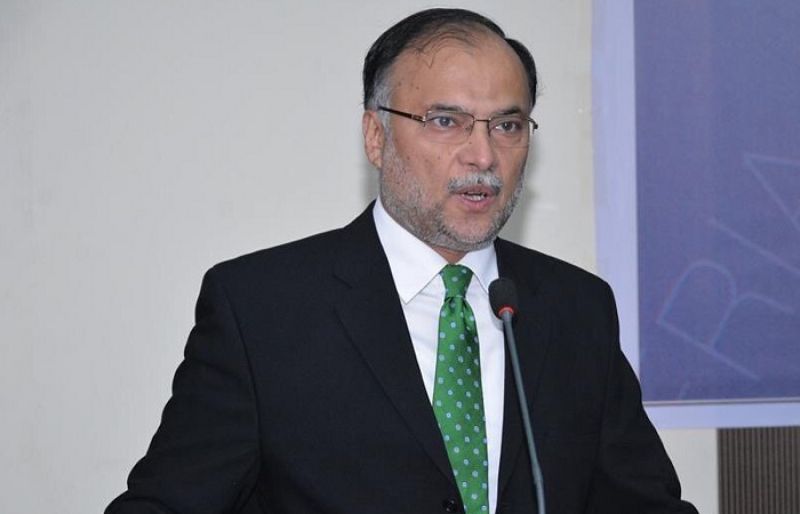
Planning Minister Ahsan Iqbal has revealed discussions about a possible plan to create 14 provinces in Pakistan, bringing the long-standing debate over administrative restructuring back into the national political spotlight.
According to Iqbal, the proposed structure would include four provinces each in Punjab and Sindh, three each in Khyber Pakhtunkhwa and Balochistan. He also referred to discussions about granting Islamabad separate provincial status, potentially through an expansion of its boundaries to include adjoining areas of Rawalpindi division.
The minister clarified that he had only heard about the proposed provincial structure and did not present it as an approved government plan. However, his remarks indicate that discussions about changing Pakistan’s administrative map have gained attention at the government level.
Iqbal said he had written to Prime Minister Shehbaz Sharif in September, recommending a committee to examine the creation of additional provinces. So far, however, no progress has been made on the proposal.
The debate is not limited to dividing existing provinces. Islamabad’s administrative structure is also under consideration. Iqbal said the prime minister had asked him to develop an alternative governance model for the federal capital after examining arrangements in other countries.
The proposed model would combine elements of local government and a provincial assembly. Islamabad could have its own legislative forum, headed by either a chief minister or mayor, with an assembly of around 25 members. The proposed composition includes 21 general seats, three seats reserved for women and one for minorities.
The plan could also introduce an elected third tier of government through union councils at a later stage. At present, legislation concerning Islamabad falls under the authority of parliament, which includes the National Assembly and Senate.
Iqbal also mentioned discussions about expanding the capital’s boundaries to incorporate parts of Rawalpindi division. Such a move could strengthen the case for granting Islamabad independent provincial status, although no final decision has been announced.
The timing of any decision on new provinces is another major consideration. Iqbal said the matter should be resolved before the Senate elections scheduled for March 2027.
The Senate currently has 96 members, with equal representation for each of Pakistan’s four provinces. The minister warned that creating new provinces after the elections could lead to demands for proportionate representation from the newly established units. Such disputes could remain unresolved throughout the six-year Senate term.
His remarks highlight an important constitutional and political challenge. Any change in provincial boundaries would require agreement on representation, resource distribution and the future balance of power in parliament. Without addressing these questions in advance, administrative restructuring could create further political complications.
Iqbal also rejected speculation about the introduction of a presidential system, saying he had not heard of any serious proposal in this regard.
Instead, he urged politicians to take ownership of the debate over new provinces and move it forward through a political process. He argued that Pakistan needed administrative reforms because provincial governments had failed to devolve functions to lower levels of government despite the passage of the 18th Amendment.
His criticism raises a broader question about the purpose of creating additional provinces. Simply dividing existing territories may not improve governance unless authority, financial resources and administrative responsibilities also reach local communities.
The debate over 14 provinces in Pakistan therefore involves much more than drawing new boundaries. It touches on provincial autonomy, political representation, administrative efficiency and the distribution of national resources.
For supporters, smaller provinces could bring governments closer to citizens and improve service delivery. However, the process could also face resistance from political parties and communities concerned about their identity, resources and representation.
The government now faces the challenge of turning these discussions into a clear and transparent political debate. Without consensus among political parties and the affected populations, any attempt to redraw Pakistan’s administrative map could create new divisions instead of resolving existing governance problems.