
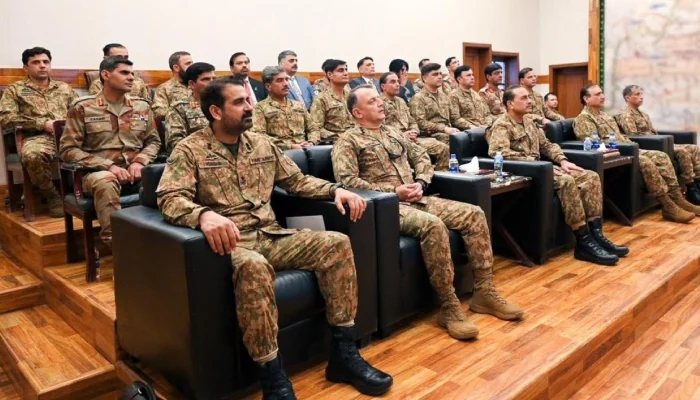
CDF Asim Munir visited Turbat in Balochistan on Thursday to review the security situation, assess ongoing counterterrorism operations and evaluate the Pakistan Army’s operational preparedness, according to the Inter-Services Public Relations (ISPR).
During the visit, Field Marshal Asim Munir received a detailed briefing on the prevailing security environment, military preparedness and ongoing operations against what the military described as externally sponsored terrorism.
The Corps Commander Balochistan received him upon arrival. The field marshal later laid a floral wreath at the Shuhada Monument and offered Fateha in honour of the martyrs.
During his interaction with troops, CDF Munir praised their professionalism, operational readiness and determination to defend the country despite challenging conditions.
He reaffirmed the Pakistan Army’s commitment to supporting the people of Balochistan in their efforts to achieve peace, prosperity and sustainable development.
The field marshal also received an update on various socio-economic development initiatives underway in the province.
His visit comes days after two Pakistan Army personnel, including a major, were martyred and eight terrorists were killed in the Kolpur area of Balochistan.
According to the ISPR, terrorists used armed quadcopters to target military vehicles on patrol on November 14. The attack claimed the lives of Major Omer Minhas Nasir and Havildar Muhammad Adnan Khan.
Balochistan and Khyber Pakhtunkhwa have faced increased militant violence in recent years. Security concerns in both provinces remain a major challenge for law enforcement agencies.
A report by the Centre for Research and Security Studies (CRSS) identified the two provinces as the main centres of violence during the second quarter of 2026, with Khyber Pakhtunkhwa recording the highest number of casualties.
According to the report, the two provinces accounted for nearly 96 per cent of all violence-related fatalities during the period. Khyber Pakhtunkhwa recorded 475 deaths, representing more than 61 per cent of the national total, while Balochistan reported 265 deaths, or 34 per cent.
Khyber Pakhtunkhwa also recorded 151 violent incidents, accounting for 57 per cent of the nationwide total. Balochistan reported 94 incidents, representing 35 per cent.
The figures highlight the continuing security challenges facing the two provinces and the scale of militant violence reported during the quarter.